
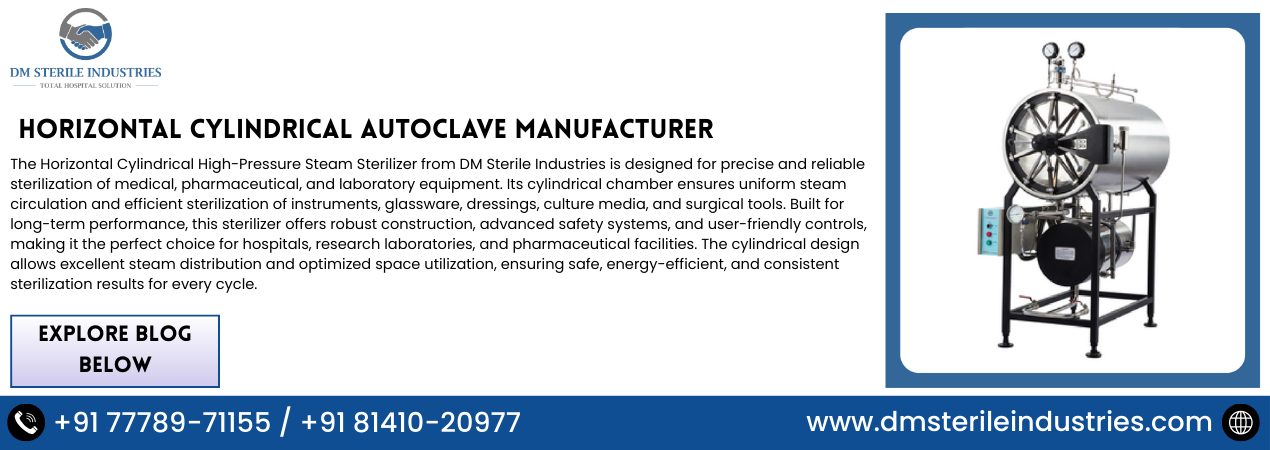
Horizontal Cylindrical Autoclave Manufacturer
Horizontal
Cylindrical Autoclave
Manufacturer
Sterilization is a critical requirement in healthcare, pharmaceutical production, research laboratories, and microbiological facilities where contamination control is essential. Equipment, surgical instruments, glassware, and culture media must be sterilized effectively before use to ensure patient safety, product purity, and research accuracy.
A horizontal cylindrical autoclave plays an important role in these sterilization processes by using pressurized steam to eliminate microorganisms, bacteria, viruses, and spores from various materials.
Horizontal Cylindrical Autoclave Manufacturer
A horizontal cylindrical autoclave manufacturer designs and produces sterilization systems capable of delivering reliable steam penetration, controlled temperature conditions, and consistent sterilization cycles.
These autoclaves are commonly used in environments where high-capacity sterilization and uniform heat distribution are required. The cylindrical chamber design ensures effective steam circulation, allowing the sterilization process to reach every surface of the instruments and materials placed inside the chamber.
Understanding Horizontal Cylindrical Autoclave Technology
A horizontal cylindrical autoclave is a steam sterilization system designed with a cylindrical chamber positioned horizontally. This configuration allows the sterilizer to handle larger loads of medical instruments, laboratory glassware, dressings, and pharmaceutical materials. The chamber design supports uniform steam distribution, which is essential for achieving consistent sterilization results across the entire load.
Steam sterilization works by exposing materials to saturated steam under controlled temperature and pressure conditions. When steam enters the chamber, it transfers thermal energy to the items being sterilized. The resulting high temperature and pressure environment effectively destroys microorganisms, including resistant bacterial spores. Because of its reliability and efficiency, steam sterilization remains one of the most widely used sterilization methods across medical and scientific industries.
A horizontal cylindrical autoclave manufacturer focuses on designing chambers that support even heat distribution, efficient steam penetration, and proper removal of trapped air. These design characteristics ensure that sterilization conditions remain stable and effective throughout the entire cycle.
Design and Construction of Horizontal Cylindrical Autoclaves
The construction of a horizontal cylindrical autoclave is carefully engineered to withstand high pressure and temperature conditions while maintaining durability and hygiene. The sterilizer chamber is typically fabricated using stainless steel materials such as SS 304 or SS 316, which provide corrosion resistance, structural strength, and easy cleaning.
The chamber is often surrounded by a double-wall or triple-wall structure that helps maintain heat insulation and improves energy efficiency. This configuration minimizes heat loss and allows the sterilizer to reach its operating temperature more efficiently. Key structural components of horizontal cylindrical autoclaves include pressure-resistant doors, secure locking systems, and high-quality sealing mechanisms. These elements help maintain the required sterilization pressure while preventing steam leakage during operation.
Control Systems and Sterilization Monitoring
Modern horizontal cylindrical autoclaves incorporate advanced control systems that allow operators to monitor and manage sterilization parameters accurately. Temperature, pressure, and sterilization cycle duration are controlled through digital microprocessor-based panels or analog control systems depending on the model.
Precise monitoring of sterilization parameters is essential to ensure that the entire load receives adequate exposure to steam. Sensors and pressure gauges help maintain stable operating conditions throughout each sterilization cycle.
Automation features may also include cycle programming, automatic steam pressure cut-off, and safety alerts. These control systems help maintain consistent sterilization performance while reducing the possibility of operational errors.
Safety Features in Horizontal Cylindrical Autoclaves
Because steam sterilization involves high pressure and temperature, safety systems are an essential component of autoclave design. Manufacturers integrate multiple safety mechanisms to ensure safe operation and protect both users and equipment.
Common safety mechanisms included in horizontal cylindrical autoclaves include:
- Automatic pressure cut-off systems that prevent excessive pressure buildup
- Safety valves that release excess steam if pressure exceeds safe limits
- Pressure gauges that allow operators to monitor chamber conditions
- Steam release valves for controlled pressure reduction
- Water level indicators to ensure adequate steam generation
- Door safety locks that prevent opening during pressurized cycles
These safety features help ensure that sterilization equipment operates reliably in demanding industrial and healthcare environments.
Applications of Horizontal Cylindrical Autoclaves
Horizontal cylindrical autoclaves are widely used in industries where contamination control and sterilization are essential for operational safety and product quality. Their high-capacity design and dependable sterilization performance make them suitable for large-scale sterilization requirements.
Common applications include:
- Hospitals and surgical centers for sterilizing surgical instruments and medical equipment
- Pharmaceutical manufacturing facilities for sterilizing production materials and containers
- Microbiology laboratories for sterilizing culture media and laboratory glassware
- Research institutions for sterilizing experimental equipment
- Biotechnology facilities for maintaining sterile conditions during research processes
- Industrial laboratories requiring contamination-free processing environments
The versatility of these sterilization systems allows them to be used across both healthcare and industrial research environments.
Advantages of Horizontal Cylindrical Autoclave Systems
Horizontal cylindrical autoclaves are widely preferred in many facilities because they provide high capacity, efficient sterilization performance, and reliable operation. Their design allows large sterilization loads to be processed while maintaining consistent steam penetration.
Key advantages include:
- Uniform steam distribution due to the cylindrical chamber design
- High load capacity suitable for hospitals and laboratories
- Reliable sterilization performance across repeated cycles
- Durable stainless steel construction for long operational life
- Energy-efficient insulation systems that reduce heat loss
- Flexible operation with manual, semi-automatic, or fully automatic control options
These advantages make horizontal cylindrical autoclaves a dependable sterilization solution across multiple industries.
Selecting a Reliable Horizontal Cylindrical Autoclave Manufacturer
Choosing the right horizontal cylindrical autoclave manufacturer is important for ensuring long-term performance, reliability, and operational safety. Sterilization equipment must meet strict standards because it directly affects infection control and product safety.
When selecting a manufacturer, organizations typically evaluate several factors related to equipment quality, engineering design, and compliance with recognized sterilization standards. Key considerations when choosing a manufacturer include:
- Quality of stainless steel construction and chamber engineering
- Reliability of control systems and safety mechanisms
- Compliance with sterilization standards such as GMP and ISO
- Availability of different chamber sizes and configuration options
- Technical support, installation assistance, and maintenance services
Careful evaluation of these factors helps healthcare facilities and laboratories ensure that their sterilization systems operate reliably in critical environments.
Future Trends in Steam Sterilization Technology
Advancements in sterilization technology continue to improve the efficiency, automation, and monitoring capabilities of autoclave systems. Modern horizontal cylindrical autoclaves increasingly incorporate digital monitoring, data logging, and programmable sterilization cycles.
These developments enable facilities to maintain better documentation of sterilization cycles, which is particularly important in regulated industries such as pharmaceuticals and healthcare. Improved insulation materials and energy management systems are also helping reduce energy consumption while maintaining effective sterilization performance.
As infection control standards and laboratory requirements continue to evolve, horizontal cylindrical autoclave manufacturers are focusing on improving automation, safety, and process reliability to support modern healthcare and research environments.
Conclusion
Horizontal cylindrical autoclaves are essential sterilization systems used in healthcare, pharmaceutical, and research environments where contamination control is critical. Their cylindrical chamber design enables efficient steam circulation and uniform sterilization performance across large loads.
With durable stainless steel construction, advanced safety mechanisms, and reliable temperature control systems, these sterilizers provide dependable performance for organizations that require consistent and controlled sterilization processes.
Frequently Asked Questions
Quick Links
Our Products
Get In Touch
Plot No. 16, Saffron Industrial Park 1. Opp V.K Bhattha, Nr Morriat Industrial Park, Indore Road. Shingarva, Ahmedubod Gujarat -302430.
info.dmsterileind@gmail.com
+91 7778971155
+91 81410 20977
DM STERILE INDUSTRIES | All Rights Reserved.