
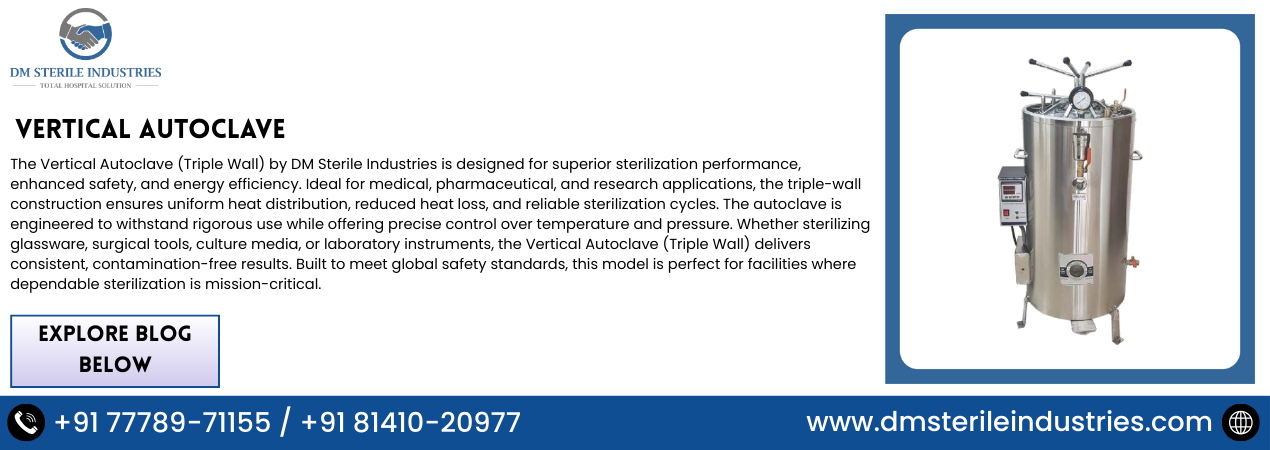
Vertical Autoclave Manufacturer in India
Vertical Autoclave Manufacturer in India
Sterilization is essential across healthcare, pharmaceutical production, research laboratories, and industrial environments. A reliable vertical autoclave ensures complete sterilization of instruments, culture media, glassware, and other materials using controlled steam under pressure. As a vertical autoclave manufacturer in India, DM Sterile Industries designs and develops double wall stainless steel autoclaves to meet structured sterilization requirements across diverse sectors.
Manufactured with precision engineering and durable materials, the vertical autoclave delivers consistent sterilization cycles, uniform heat distribution, and operational safety. It is suitable for hospitals, research facilities, pharmaceutical units, diagnostic laboratories, and industrial sterilization setups that require dependable, repeatable performance.
Understanding the Role of a Vertical Autoclave in Modern Sterilization
A vertical autoclave is a steam sterilization system designed with a top-loading chamber configuration. It uses saturated steam at controlled pressure and temperature to eliminate bacteria, viruses, fungi, and spores. The double wall construction enhances thermal efficiency and supports uniform heat circulation throughout the chamber.
Unlike smaller tabletop sterilizers, vertical autoclaves are built for medium to high-capacity sterilization requirements. They are widely used in environments where repetitive, batch-based sterilization is performed daily. The compact vertical design optimizes floor space while maintaining substantial chamber capacity.
Double Wall Construction and Its Operational Advantage
The double wall structure is a defining feature of this autoclave model. Both the inner and outer chambers are manufactured from stainless steel (SS 304 or SS 316, depending on application needs). This construction ensures structural strength, durability, and improved thermal insulation.
The benefits of double wall construction include:
- Enhanced thermal efficiency and heat retention
- Reduced external surface temperature for improved operator safety
- Improved steam circulation and uniform temperature distribution
- Lower heat loss during sterilization cycles
This design helps maintain consistent sterilization conditions throughout the chamber, minimizing cold spots and ensuring effective microbial elimination.
Key Features of the Vertical Autoclave
The vertical autoclave is engineered to balance performance, safety, and long-term durability. Depending on the selected model, it incorporates mechanical or digital control systems.
Important features include:
- Stainless steel double wall construction
- Efficient steam circulation system
- Pressure gauge for chamber monitoring
- Steam release valve for controlled depressurization
- Safety valve for pressure protection
- Digital microprocessor controller or analog thermostat (model dependent)
- Automatic pressure cut-off mechanism
- High-grade glass wool or ceramic fiber insulation
- Fast heating mechanism to reduce cycle time
- Multiple chamber size options
These integrated features support safe operation while maintaining consistent and effective sterilization cycles.
Technical Specifications Overview
The vertical autoclave manufacturer in India offers structured technical configurations suited to different application scales and operational capacities.
These specifications allow institutions to select a configuration aligned with their sterilization load and infrastructure capacity.
Applications Across Industries
Vertical autoclaves are widely used in professional environments where sterilization accuracy and reliability are mandatory.
Hospitals and Healthcare Centers
Medical instruments such as surgical tools, dressings, and trays require steam sterilization before use. The autoclave ensures effective microbial elimination while maintaining instrument integrity.
Pharmaceutical Manufacturing
In pharmaceutical facilities, sterilization of culture media, glass containers, and process equipment is essential for controlled production. Consistent temperature and pressure control support regulatory compliance.
Diagnostic Laboratories
Laboratories rely on autoclaves for sterilizing glassware, culture media, and biological waste before disposal. Uniform steam distribution ensures reliable sterilization across varied materials.
Research Institutions
Academic and research laboratories require dependable sterilization for microbiological studies and experimental work. The vertical configuration enables efficient batch processing.
Industrial Sterilization
Certain industrial operations require sterilization of components, tools, and packaging materials. A double wall vertical autoclave provides durable performance under repetitive operational cycles.
Why Vertical Autoclave Demand Is Growing in India
India's healthcare and pharmaceutical sectors continue to expand, increasing the need for reliable sterilization equipment. Hospitals are upgrading sterilization infrastructure, while pharmaceutical and biotech industries are strengthening quality and compliance standards.
As infection control protocols become more structured, institutions prioritize equipment that offers operational safety, durability, and compliance-ready performance. Vertical autoclaves with stainless steel construction and integrated safety features are increasingly preferred for institutional use.
The growing laboratory and diagnostic infrastructure in tier-2 and tier-3 cities has also contributed to increased autoclave installations. Reliable domestic manufacturers play an important role in ensuring accessible service support and standardized engineering quality.
Safety and Operational Reliability
Steam sterilization involves high pressure and temperature, making safety systems essential. The vertical autoclave integrates:
- Automatic pressure cut-off system
- Safety valve to prevent excess pressure
- Steam release valve for controlled depressurization
- Insulated outer chamber to reduce heat exposure
These mechanisms protect both equipment and operators. A structured safety design supports long-term operational reliability, even under frequent daily use.
Energy Efficiency and Thermal Insulation
Thermal insulation directly influences energy performance. The use of glass wool or ceramic fiber minimizes heat loss during operation. Efficient insulation supports faster heating cycles and helps maintain chamber temperature with optimized power consumption.
For institutions operating multiple sterilization cycles daily, energy-efficient design contributes to long-term operational stability without compromising sterilization effectiveness.
Factors to Consider Before Choosing a Vertical Autoclave
Selecting the right vertical autoclave requires a clear understanding of operational requirements. Buyers should evaluate:
- Required chamber capacity
- Daily sterilization volume
- Power supply compatibility
- Preference for digital or analog controls
- Required safety features
- Compliance and documentation support
- Availability of service and maintenance support
Assessing these parameters ensures the selected system aligns with institutional workflows and sterilization protocols.
Maintenance and Longevity
Routine maintenance is essential for consistent sterilization performance. Regular inspection of pressure valves, temperature sensors, gaskets, and sealing components is recommended. Stainless steel construction reduces corrosion risk and supports extended service life.
Proper drainage of residual water and routine chamber cleaning help maintain hygiene standards. With preventive maintenance and correct operation, a vertical autoclave can provide reliable performance over an extended period.
Frequently Asked Questions
Get in Touch
Quick Links
Our Products
Get In Touch
Plot No. 16, Saffron Industrial Park 1. Opp V.K Bhattha, Nr Morriat Industrial Park, Indore Road. Shingarva, Ahmedubod Gujarat -302430.
info.dmsterileind@gmail.com
+91 7778971155
+91 81410 20977
DM STERILE INDUSTRIES | All Rights Reserved.