
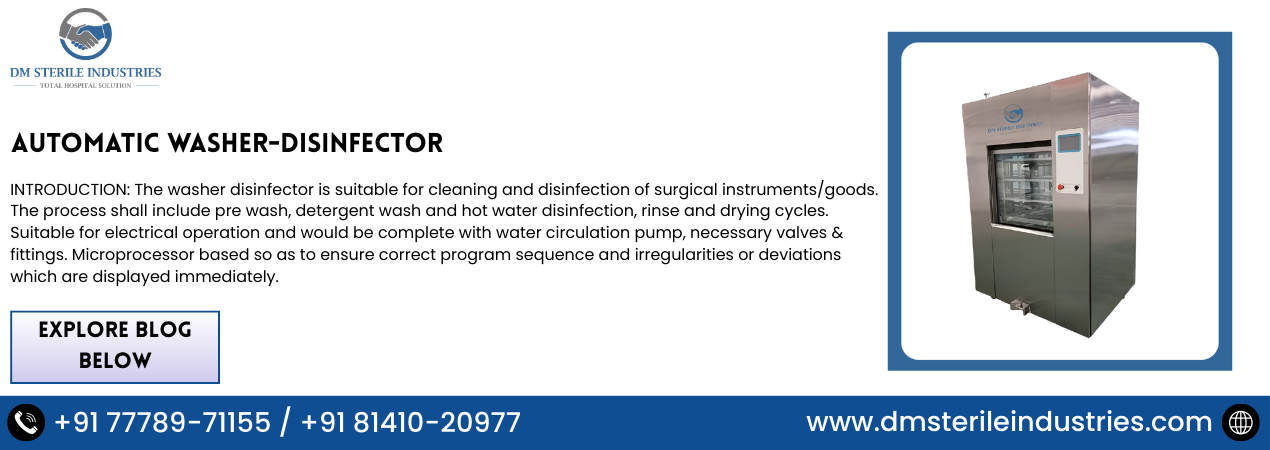
Healthcare and pharmaceutical facilities across Gujarat operate under increasingly strict infection control and regulatory frameworks. From tertiary hospitals and surgical centers to pharmaceutical manufacturing units, consistent and validated cleaning of reusable medical instruments is now a fundamental operational requirement. In this environment, the automatic washer-disinfector plays a vital role in supporting patient safety, compliance, and workflow efficiency. Demand for automatic washer-disinfectors in Gujarat continues to rise due to expanding healthcare infrastructure, growth in pharmaceutical production, and the wider adoption of centralized sterile services departments.
An automatic washer-disinfector is more than a conventional cleaning unit. It is a controlled, validated system designed to remove organic residues, significantly reduce microbial load, and prepare instruments for downstream sterilization. Facilities evaluating instrument reprocessing solutions must clearly understand how these systems operate, where they are applied, and how to select equipment aligned with their operational demands.
Understanding Automatic Washer-Disinfector Technology
An automatic washer-disinfector is engineered to perform standardized cleaning and thermal disinfection of surgical instruments, anesthesia equipment, containers, and other reusable medical devices. The process is fully automated and follows pre-programmed cycles that typically include pre-wash, detergent washing, rinsing, thermal disinfection, and drying. Automation ensures consistency, traceability, and repeatable results across every cycle.
Compared to manual or semi-automatic methods, washer-disinfectors use precisely controlled water temperature, mechanical action through spray arms, and calibrated chemical dosing to achieve validated cleaning outcomes. Microprocessor-based controls continuously monitor process parameters, allowing deviations to be detected and corrected immediately. This level of control is critical in healthcare environments where cleaning failures can directly affect infection control outcomes.
Why Automatic Washer-Disinfectors Are Critical for CSSD Operations
Central Sterile Services Departments manage large volumes of reusable instruments under strict time and quality constraints. Manual cleaning introduces variability and relies heavily on individual operator technique, increasing the risk of residual contamination. Automatic washer-disinfectors address these limitations by standardizing each stage of the cleaning and disinfection process.
When integrated into CSSD workflows, washer-disinfectors improve throughput while maintaining consistent quality. Instruments exit the system visibly clean, thermally disinfected, and ready for inspection, packaging, and sterilization. This structured approach supports compliance with hospital accreditation standards and internationally recognized infection control guidelines.
Functional Design and Construction Considerations
The effectiveness of an automatic washer-disinfector is closely linked to its construction and internal design. Chambers manufactured from stainless steel 316L provide excellent resistance to corrosion, detergents, and disinfectants while maintaining hygienic surfaces. Rounded internal corners and electro-polished finishes reduce the risk of residue buildup and microbial growth.
Modern systems are designed to accommodate multi-level wash carts and standardized DIN trays, supporting efficient instrument loading. Glass doors and internal illumination allow visual monitoring without interrupting the cycle. Features such as self-cleaning chambers and integrated debris filtration help reduce maintenance requirements and enhance long-term reliability.
Control Systems and Process Validation
Control systems form the operational core of automatic washer-disinfectors. Microprocessor-based controllers manage cycle sequencing, temperature regulation, chemical dosing, and safety interlocks. Password-protected access ensures that validated programs remain unchanged, preserving process consistency.
Clear cycle data is displayed on LCD panels, enabling operators to monitor each phase of the process. Communication interfaces such as RS232 and RS485 support integration with hospital documentation and traceability systems. This level of transparency is essential for facilities undergoing audits, inspections, or accreditation assessments.
Cleaning, Disinfection, and Drying Process Phases
The cleaning and disinfection cycle of an automatic washer-disinfector is designed to progressively remove contaminants while protecting instrument integrity. Each phase contributes to the overall effectiveness of the reprocessing workflow.
The process typically includes:
Process Phases
Thermal disinfection is achieved by maintaining temperatures of at least 90°C for validated time periods. Independent temperature probes continuously verify these conditions. Drying systems that incorporate heat exchangers, condensers, and H14 HEPA filtration ensure instruments leave the chamber dry and protected from airborne contamination.
Energy Efficiency and Environmental Considerations
Healthcare facilities in Gujarat are increasingly focused on responsible resource utilization. Modern automatic washer-disinfectors are designed to minimize water, energy, and chemical consumption while maintaining validated performance. High-efficiency valves reduce filling and draining times, shortening total cycle duration.
Heat recovery systems and optimized spray arm geometry improve thermal efficiency. Reduced noise levels and ergonomic service access contribute to a more sustainable and staff-friendly working environment, particularly in high-throughput facilities operating multiple units daily.
Applications Across Healthcare and Pharmaceutical Sectors
Automatic washer-disinfectors are used across a broad range of clinical and industrial settings where validated cleaning is essential. Their adaptability makes them a core element of contemporary reprocessing infrastructure.
Common application areas include:
Each application requires reliable and repeatable cleaning outcomes to support subsequent sterilization steps. Washer-disinfectors provide the controlled conditions needed to meet these requirements consistently.
Gujarat as a Growing Hub for Medical Equipment Adoption
Gujarat has established itself as a major center for healthcare expansion and pharmaceutical manufacturing in India. Cities such as Ahmedabad, Surat, Vadodara, and Rajkot host a high concentration of hospitals, medical colleges, and pharmaceutical facilities. This growth has driven investment in advanced infection control and reprocessing infrastructure.
Facilities across the state are adopting automatic washer-disinfectors to align with international best practices and regulatory expectations. Local access to technical support, service expertise, and compliance-ready equipment further accelerates adoption throughout Gujarat.
How to Select the Right Automatic Washer-Disinfector
Selecting an automatic washer-disinfector requires careful assessment of operational needs, instrument volumes, and facility layout. Both current demands and future expansion plans should be considered during evaluation.
Key selection factors include:
A structured selection approach helps ensure the system integrates smoothly into existing workflows and supports long-term operational stability.
Maintenance, Safety, and Long-Term Reliability
Regular maintenance is essential to sustain washer-disinfector performance over time. Designs that offer easy access to electrical components, self-cleaning filters, and modular assemblies simplify servicing and reduce downtime. Audible and visual alerts notify operators of process deviations, chemical shortages, or system faults.
Integrated safety features such as pressure monitoring, automatic shut-offs, and secure door interlocks protect both personnel and equipment. With proper maintenance, automatic washer-disinfectors deliver reliable performance over extended service life, supporting uninterrupted reprocessing operations.
Conclusion
Automatic washer-disinfectors are now a fundamental component of healthcare and pharmaceutical infrastructure in Gujarat. By delivering validated, repeatable cleaning and disinfection outcomes, these systems support patient safety, regulatory compliance, and efficient operations. As facilities continue to expand and adopt advanced reprocessing standards, washer-disinfectors will remain central to effective infection control workflows.
Frequently Asked Questions
An automatic washer-disinfector is used to clean and thermally disinfect reusable medical instruments in a controlled, validated manner prior to sterilization or reuse.
Manual cleaning depends on operator technique and visual inspection, while washer-disinfectors rely on programmed cycles, controlled temperatures, and mechanical action to deliver consistent outcomes.
Yes, they are commonly used in pharmaceutical environments to clean process tools, containers, and reusable equipment under validated conditions.
Modern systems are designed to align with hospital infection control protocols and international guidelines governing thermal disinfection and instrument reprocessing.
Cycle duration is generally around 45 minutes, depending on load configuration and selected program parameters.
Thermal disinfection uses controlled high temperatures to reliably reduce microbial load without relying solely on chemical agents.