
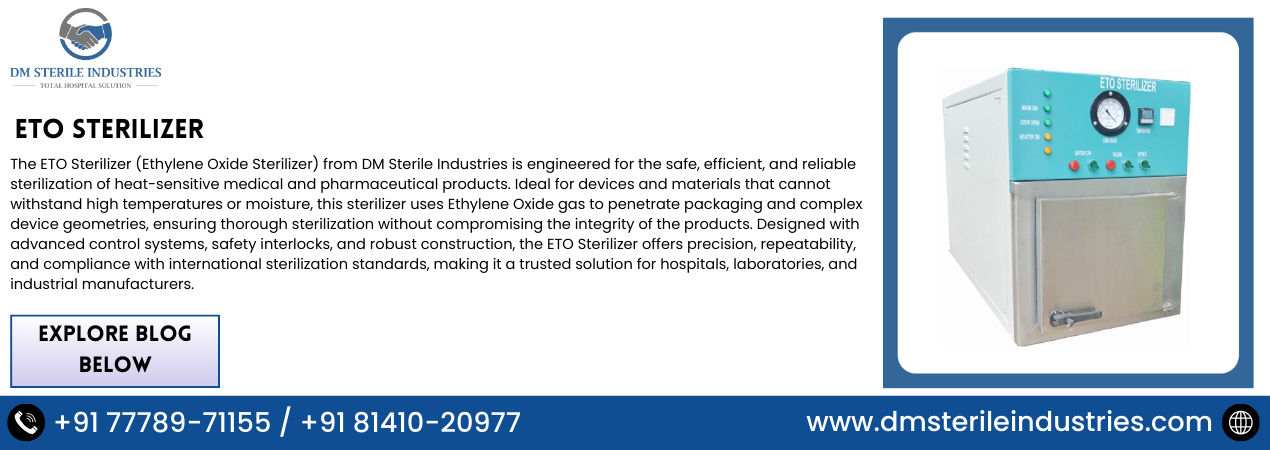
ETO Sterilizer for Hospital in Ahmedabad
Hospitals increasingly depend on advanced sterilization systems to maintain patient safety, effective infection control, and regulatory compliance. Among low-temperature sterilization technologies, Ethylene Oxide sterilization continues to be one of the most reliable methods for processing complex, heat-sensitive medical devices. An ETO Sterilizer for Hospital in Ahmedabad plays an essential role in supporting modern healthcare operations, particularly where reusable instruments, packaged devices, and delicate materials must be sterilized without material damage.
Healthcare Hub Demands Advanced Sterilization
Ahmedabad, as a key healthcare and medical manufacturing hub in Gujarat, has witnessed consistent demand for hospital-grade ETO sterilizers that meet international safety and performance standards. Understanding how these systems function, where they are applied, and what hospitals should evaluate before implementation helps decision-makers adopt sterilization solutions that are safe, compliant, and operationally efficient.
Understanding ETO Sterilization in Hospital Environments
Ethylene Oxide sterilization is a low-temperature process developed for medical products that cannot tolerate steam, high heat, or moisture. In hospital environments, many devices contain polymers, electronics, adhesives, or multilayer packaging that may degrade under conventional steam sterilization. ETO gas penetrates complex geometries and sealed packaging, ensuring effective microbial inactivation while preserving material integrity.
Hospitals primarily use ETO sterilizers for critical and semi-critical items unsuitable for autoclaves. The process involves controlled exposure to Ethylene Oxide gas under regulated temperature, humidity, and pressure, followed by aeration to remove residual gas. This controlled method allows hospitals to maintain sterilization efficacy while safeguarding staff and patient health.
Why Hospitals in Ahmedabad Use ETO Sterilizers
Ahmedabad hosts a dense network of multi-specialty hospitals, diagnostic centers, surgical facilities, and medical colleges. These institutions routinely handle advanced surgical instruments, implants, and specialty devices that require reliable low-temperature sterilization. As medical devices become more complex, hospitals increasingly rely on ETO sterilization as part of their CSSD and infection control protocols.
The city's proximity to medical device manufacturers, pharmaceutical units, and testing facilities also supports adherence to international standards such as ISO 11135 and GMP guidelines. An ETO Sterilizer for Hospital in Ahmedabad helps meet these expectations through validated cycles, traceable process control, and consistent sterilization results.
Functional Overview of a Hospital-Grade ETO Sterilizer
A hospital-grade ETO sterilizer is engineered to deliver precise, repeatable sterilization cycles with a strong focus on safety and compliance. The system typically includes a stainless steel chamber, vacuum and gas dosing mechanisms, control panels, and integrated safety interlocks. Each component contributes to accurate process control and effective microbial reduction.
The sterilization cycle generally consists of pre-conditioning, gas exposure, and aeration. During pre-conditioning, temperature and humidity are stabilized to enhance gas effectiveness. Gas exposure enables Ethylene Oxide to penetrate devices and packaging, inactivating microorganisms at a molecular level. Aeration then reduces residual gas to safe limits before items are released for clinical use.
Advanced microprocessor- or PLC-based controls allow hospital staff to manage parameters, record cycle data, and maintain traceability for quality assurance and audits.
Key Safety and Compliance Considerations in Hospitals
Safety is a critical consideration when using Ethylene Oxide in hospital settings. While highly effective, ETO requires controlled handling due to its toxic and flammable nature. Hospital ETO sterilizers are therefore equipped with multiple safety systems to protect users and surrounding areas.
Modern units incorporate automatic door locking, leak detection sensors, pressure control systems, and emergency shutdown features. Gas scavenging and exhaust mechanisms help limit environmental exposure and support compliance with occupational safety standards. These safeguards are particularly important in hospitals where sterilization units operate near patient care and staff areas.
Compliance with standards such as ISO 11135 ensures that sterilization processes are validated, reproducible, and properly documented. Hospitals in Ahmedabad often align sterilization practices with national regulations and accreditation requirements, making certified ETO systems a core infrastructure element.
Applications of ETO Sterilizers in Hospitals
ETO sterilizers are used across multiple hospital departments due to their versatility. Common applications include sterilization of surgical instruments, anesthesia equipment, catheters, endoscopes, implants, and reusable disposable medical devices. Laboratory instruments and specialized diagnostic tools that cannot withstand heat are also frequently processed using ETO systems.
In facilities with high surgical volumes, ETO sterilization supports infection prevention programs by ensuring consistent and thorough sterilization of complex instruments. This is particularly critical in orthopedic, cardiac, neurosurgical, and minimally invasive procedures where device performance and sterility are essential.
ETO Sterilizer Integration with Hospital CSSD Operations
Central Sterile Supply Departments are central to hospital sterilization workflows. Integrating an ETO sterilizer into CSSD operations requires careful planning to ensure efficient material flow, safety compliance, and validated processes. Hospitals typically designate dedicated areas for ETO sterilization to manage gas handling, aeration, and continuous monitoring.
Effective integration involves staff training, clear standard operating procedures, and routine maintenance programs. Hospitals in Ahmedabad often emphasize documentation and traceability to meet accreditation and audit requirements. ETO sterilizers with built-in data logging and cycle recording features help streamline these processes and strengthen quality management systems.
Factors Hospitals Should Consider Before Selecting an ETO Sterilizer
Selecting an ETO sterilizer requires evaluation of clinical needs, operational capacity, and compliance requirements. Hospitals should assess chamber size based on instrument volume, packaging dimensions, and expected turnaround times. Temperature and pressure ranges must be compatible with the devices being processed.
- Automation level and control system design influence ease of operation, consistency, and documentation quality
- Safety features, environmental controls, and risk management capabilities should align with hospital standards
- Local service availability and technical support are important considerations, especially for facilities running continuous sterilization cycles
When evaluating an ETO Sterilizer for Hospital in Ahmedabad, decision-makers often consider compatibility with existing infrastructure, power requirements, and regulatory expectations applicable within Gujarat and at the national level.
Regulatory and Quality Expectations in Ahmedabad Healthcare Facilities
Hospitals in Ahmedabad operate within a regulated healthcare framework that emphasizes patient safety, infection control, and validated processes. Sterilization systems must meet national requirements and align with international best practices. Hospital-grade ETO sterilizers typically support validation protocols, routine monitoring, and periodic requalification.
Quality teams rely on documented sterilization data to demonstrate compliance during inspections and audits. Consistent ETO sterilization performance helps reduce the risk of healthcare-associated infections and supports overall hospital quality objectives.
Environmental and Operational Responsibility
Environmental responsibility is an increasingly important factor in hospital operations. Modern ETO sterilizers incorporate gas scavenging and exhaust treatment systems to limit environmental impact. Efficient aeration processes reduce residual gas levels, supporting safer working conditions and responsible emissions management.
Hospitals in Ahmedabad, particularly those expanding or upgrading facilities, often seek sterilization solutions that balance effectiveness with environmental and occupational safety. Proper system design and adherence to operational protocols help ensure ETO sterilization remains a sustainable part of hospital operations.
Future Outlook for ETO Sterilization in Hospitals
As medical devices continue to advance, demand for low-temperature sterilization methods is expected to increase. ETO sterilization remains relevant due to its ability to process complex materials and packaged devices effectively. In Ahmedabad's growing healthcare sector, hospitals are likely to continue investing in validated, compliant ETO systems that support advanced clinical care.
Ongoing improvements in control technology, safety systems, and monitoring capabilities are enhancing the reliability and usability of hospital ETO sterilizers. These developments enable healthcare facilities to maintain high sterilization standards while adapting to evolving regulatory and clinical requirements.
Comprehensive Device Coverage
- Heat- and moisture-sensitive devices such as plastic instruments, catheters, endoscopes, and implants
- Equipment with electronic components that cannot be processed using steam sterilization
- Surgical instruments used in orthopedic, cardiac, neurosurgical, and minimally invasive procedures
- Anesthesia equipment and specialized diagnostic tools requiring low-temperature processing
- Reusable disposable medical devices and laboratory instruments