
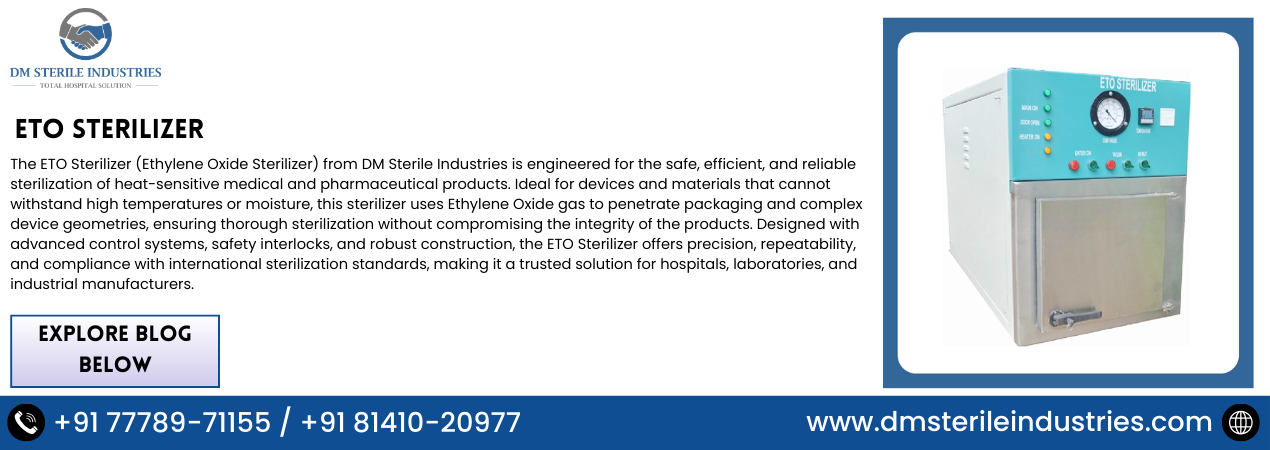
ETO Sterilizer Manufacturer in Ahmedabad
ETO Sterilizer Manufacturer in Ahmedabad
Healthcare and pharmaceutical environments depend on sterilization systems that ensure patient safety, regulatory compliance, and consistent process control. Among low-temperature sterilization technologies, Ethylene Oxide (ETO) sterilization plays a vital role where heat- or moisture-based methods are unsuitable. Ahmedabad, as a growing center for medical device manufacturing and healthcare infrastructure, has seen rising demand for reliable ETO sterilizers driven by expanding hospitals, pharmaceutical units, and export-oriented device manufacturers.
This article explains ETO sterilization in detail, covering its working principles, applications, regulatory requirements, and the importance of selecting a technically capable ETO sterilizer manufacturer in Ahmedabad for long-term operational reliability.
Understanding ETO Sterilization Technology
ETO sterilization is a low-temperature, gas-based process used to sterilize medical devices, pharmaceutical products, and laboratory materials that are sensitive to heat, steam, or radiation. Ethylene Oxide gas offers excellent penetration, allowing it to reach complex geometries, sealed packaging, and porous materials without causing physical or chemical damage.
The process involves controlled exposure to ETO gas under specific temperature, pressure, humidity, and time conditions. After exposure, a dedicated aeration phase removes residual gas to ensure product safety. Because of these precise requirements, ETO sterilization systems must be engineered with high accuracy and reliable safety mechanisms.
Why ETO Sterilizers Are Essential for Modern Healthcare
Many medical and pharmaceutical products cannot tolerate steam sterilization or dry heat. Devices such as catheters, syringes, surgical kits, plastic components, and electronic medical equipment require sterilization methods that preserve material integrity while ensuring effective microbial elimination.
ETO sterilizers provide a validated solution that balances sterilization effectiveness with material safety. Their use is well established in hospitals, central sterile supply departments, pharmaceutical manufacturing units, and medical device production facilities across India and international markets.
How an ETO Sterilizer Works
An ETO sterilizer operates through a structured cycle designed to eliminate microorganisms while maintaining process consistency. A typical cycle includes the following stages:
- Pre-conditioning, where temperature and humidity are stabilized inside the chamber
- Vacuum creation to remove air and enable uniform gas distribution
- Controlled gas charging using Ethylene Oxide or ETO and CO? mixtures
- Exposure, during which products remain under defined conditions for sterilization
- Aeration to remove residual gas and ensure safe handling
Each phase is monitored through automated control systems to maintain validated parameters and repeatable results.
Key Components of an Industrial ETO Sterilizer
Industrial ETO sterilizers are built with specialized components focused on safety, accuracy, and durability. Chambers are typically manufactured from stainless steel grades such as SS 304 or SS 316 to provide corrosion resistance and long service life. High-efficiency vacuum pumps, gas dosing systems, and exhaust scavenging units form the core mechanical elements.
Advanced control panels, commonly PLC or microprocessor-based, manage cycle programming, data logging, alarm systems, and safety interlocks. These features help maintain process consistency and support regulatory documentation requirements.
Applications of ETO Sterilizers Across Industries
ETO sterilization is widely used across sectors where sterility and product integrity are critical. Common application areas include:
- Sterilization of heat-sensitive medical devices and disposables
- Pharmaceutical packaging materials and drug delivery systems
- Surgical instruments with complex assemblies
- Laboratory equipment and diagnostic components
- Biotechnology and research materials requiring low-temperature sterilization
These applications require precise control and validated performance, making equipment selection a key operational decision.
Regulatory and Compliance Requirements for ETO Sterilization
ETO sterilization systems must comply with strict national and international standards to ensure safety and process validation. Standards such as ISO 11135 define requirements for the development, validation, and routine control of ETO sterilization processes for medical devices.
Good Manufacturing Practices emphasize documentation, repeatability, and traceability. Equipment manufacturers must design systems that support compliance through features such as data logging, alarm monitoring, and process verification. Healthcare and manufacturing facilities are required to follow standard operating procedures aligned with these frameworks.
Why Ahmedabad Is a Strategic Location for ETO Sterilizer Manufacturing
Ahmedabad has emerged as a significant industrial and healthcare manufacturing center in Gujarat. The region hosts pharmaceutical companies, medical device manufacturers, hospitals, and research institutions that depend on advanced sterilization infrastructure.
Access to skilled engineering talent, proximity to pharmaceutical clusters, and strong industrial supply chains make Ahmedabad a practical base for ETO sterilizer manufacturing. Local manufacturers are well positioned to understand regulatory expectations, installation environments, and service requirements specific to Indian healthcare and pharmaceutical facilities.
What to Consider When Choosing an ETO Sterilizer Manufacturer in Ahmedabad
Selecting an ETO sterilizer manufacturer involves more than evaluating chamber size or capacity. Buyers should assess technical expertise, process understanding, and long-term support capability. Key evaluation factors include:
- Experience in ETO sterilization system design and validation
- Knowledge of ISO 11135 and GMP compliance requirements
- Customization options for chamber size and automation levels
- Integration of safety features such as leak detection and emergency shutdown
- Availability of after-installation support, documentation, and service
A technically capable manufacturer supports not only equipment supply but also operational readiness.
Role of Automation and Control Systems in ETO Sterilizers
Modern ETO sterilizers rely on automation to maintain consistency and safety. PLC or microprocessor-based control systems regulate temperature, pressure, humidity, and gas concentration throughout the cycle.
Automated data recording supports batch traceability, validation reporting, and audit preparedness. Alarm systems and safety interlocks reduce human error and enhance operator protection, particularly in regulated environments and export-oriented operations.
Safety Considerations in ETO Sterilization Systems
Ethylene Oxide is an effective sterilant but requires controlled handling due to its flammable and toxic nature. Industrial ETO sterilizers are designed with multiple safety layers, including precise gas dosing, pressure monitoring, leak detection, and exhaust scavenging systems.
Proper chamber sealing, automated door locking, emergency stop functions, and adequate aeration ensure residual gas levels remain within permissible exposure limits before products are handled.
Customization and Capacity Options for ETO Sterilizers
ETO sterilizers are available in a range of capacities, from compact laboratory units to large industrial systems designed for high-volume processing. Customization may include chamber configuration, loading methods, automation level, and control interface design.
Manufacturers often adapt systems based on product type, batch size, facility layout, and regulatory needs, allowing seamless integration into existing workflows.
Importance of Installation, Validation, and Documentation
Correct installation and validation are essential for achieving reliable sterilization outcomes. Manufacturers typically support installation qualification, operational qualification, and performance qualification to confirm system performance within defined parameters.
Comprehensive documentation, including user manuals, validation protocols, and maintenance guidelines, supports compliance and audit readiness. Facilities benefit from working with manufacturers who provide structured technical documentation aligned with regulatory expectations.
Maintenance and Lifecycle Support
ETO sterilization systems are long-term assets that require regular maintenance to ensure consistent performance. Routine inspection of seals, sensors, vacuum systems, and safety components is essential.
Access to local technical support in Ahmedabad helps reduce downtime and supports timely resolution of operational issues. Preventive maintenance programs also contribute to system longevity and sustained compliance.
Frequently Asked Questions
ETO sterilization is suitable for heat- and moisture-sensitive products such as plastic medical devices, electronic components, surgical disposables, pharmaceutical packaging, and complex assemblies that cannot tolerate steam or dry heat.
When performed using compliant equipment and validated processes, ETO sterilization is safe and effective. Proper aeration and residual gas monitoring ensure products meet safety limits before use.
Cycle duration depends on product type, load configuration, and process parameters. A complete cycle, including aeration, can range from several hours to more than a day.
ETO sterilization systems are governed by standards such as ISO 11135 and GMP guidelines, which define validation, routine control, documentation, and safety requirements.
ETO sterilizers can be customized for chamber size, automation level, control systems, and safety features to meet specific facility and product needs.
Local manufacturing and service support enable faster installation, responsive maintenance, and better alignment with regional regulatory and operational requirements.
Get in Touch
Quick Links
Our Products
Get In Touch
Plot No. 16, Saffron Industrial Park 1. Opp V.K Bhattha, Nr Morriat Industrial Park, Indore Road. Shingarva, Ahmedubod Gujarat -302430.
info.dmsterileind@gmail.com
+91 7778971155
+91 81410 20977
DM STERILE INDUSTRIES | All Rights Reserved.