
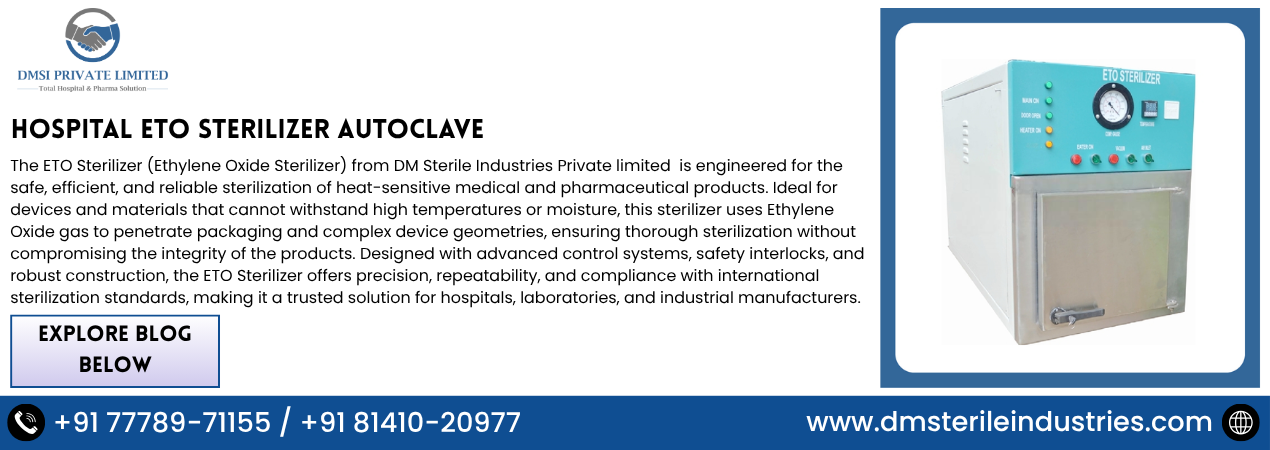
Hospital ETO Sterilizer Autoclave
Hospital ETO Sterilizer Autoclave
A Hospital ETO Sterilizer Autoclave is an important sterilization system used for medical products, surgical items, laboratory equipment, pharmaceutical materials, and heat-sensitive healthcare devices.
Hospital ETO Sterilizer Autoclave
In hospitals and medical facilities, sterilization is not just a routine process; it is a critical part of infection control and patient safety. Many medical products cannot be sterilized with high-temperature steam because they may lose shape, strength, or functional performance. For such products, Ethylene Oxide sterilization offers a safe and controlled low-temperature method.
ETO stands for Ethylene Oxide, a sterilizing gas known for its ability to penetrate packaging, tubes, narrow spaces, and complex product surfaces. This makes a Hospital ETO Sterilizer Autoclave suitable for delicate materials such as plastic devices, rubber parts, catheters, syringes, surgical disposables, packed medical products, and certain electronic medical components.
DM Sterile Industries manufactures ETO Sterilizer systems designed for safe, efficient, and reliable sterilization of heat-sensitive medical and pharmaceutical products. The system is engineered with stainless steel construction, automated cycle control, vacuum support, safety interlocks, leak detection, pressure monitoring, and gas exhaust safety arrangements. These features help hospitals and healthcare-related industries maintain sterilization quality while supporting operator safety.
Understanding Hospital ETO Sterilizer Autoclave
A Hospital ETO Sterilizer Autoclave is designed to sterilize products using Ethylene Oxide gas under controlled conditions. Unlike steam autoclaves, which use high temperature and moisture, ETO sterilizers operate at lower temperatures. This makes them suitable for materials that cannot tolerate heat, humidity, or pressure during sterilization.
The sterilization process usually includes pre-conditioning, vacuum creation, gas charging, exposure, gas evacuation, and aeration. During the exposure stage, Ethylene Oxide gas reaches the product surface and penetrates packaging or narrow spaces. After exposure, the aeration stage helps remove remaining gas from the product and chamber before the items are handled or used.
This process is widely used in hospitals, laboratories, medical device manufacturing units, pharmaceutical facilities, and sterile packaging areas. It is especially useful when products have complex shapes or are sealed in packaging before sterilization.
Why Hospitals Use ETO Sterilization
Hospitals use different sterilization methods depending on the type of instruments and materials being processed. Steam sterilization is suitable for many metal instruments, but it is not ideal for every medical product. Some healthcare items are made from plastic, rubber, polymer, or mixed materials that can be damaged by steam.
ETO sterilization helps solve this challenge by offering low-temperature sterilization with strong penetration capability. It can sterilize products without exposing them to high heat or excess moisture. This makes it suitable for surgical disposables, diagnostic accessories, delicate tubes, packed devices, and other sensitive hospital materials.
A Hospital ETO Sterilizer Autoclave supports infection control practices by reducing the risk of microbial contamination. It also helps maintain the usability and quality of medical products that require gentle sterilization conditions.
Key Features of Hospital ETO Sterilizer Autoclave
A well-designed ETO Sterilizer should provide accuracy, safety, and repeatable sterilization performance. Since Ethylene Oxide gas must be handled carefully, the machine should include proper safety and control systems.
Key features include:
- Suitable for heat-sensitive and moisture-sensitive medical products
- Stainless steel chamber construction using SS 304 or SS 316 material
- Fully automated sterilization cycle control
- Microprocessor or PLC-based operating panel
- Vacuum pump for air removal and proper gas distribution
- Controlled gas exposure and aeration process
- Automatic door locking system for safety
- Pressure control and leak detection arrangement
- Emergency stop system for quick shutdown
- Gas scavenging and exhaust safety system
- Adjustable temperature operation
- Suitable for packed products and complex device shapes
- Designed to support GMP, ISO 11135, and CE quality expectations
These features help improve process consistency and reduce manual handling errors. Automated operation is especially useful in hospital and industrial sterilization areas where cycle accuracy is important.
Working Process of Hospital ETO Sterilizer Autoclave
The Hospital ETO Sterilizer Autoclave works through a controlled sterilization cycle. Each stage has a specific role in achieving effective sterilization while maintaining product safety.
The process generally includes:
- Pre-conditioning of the load before sterilization
- Vacuum creation to remove air from the chamber
- Ethylene Oxide gas charging inside the chamber
- Controlled exposure for sterilization action
- Gas evacuation after exposure completion
- Aeration to remove residual gas from products
- Final safety check before unloading
Pre-conditioning prepares the products for proper gas exposure. Vacuum creation removes air so Ethylene Oxide gas can reach all surfaces more effectively. During the exposure stage, the gas acts on microorganisms present on the product. After exposure, aeration supports safer handling by reducing residual gas from the products and chamber.
Applications of Hospital ETO Sterilizer Autoclave
ETO Sterilizer Autoclaves are used wherever low-temperature sterilization is required. Their ability to sterilize packed, delicate, and complex products makes them valuable in healthcare and industrial environments.
Common applications include:
- Hospital sterilization departments
- Surgical instrument processing areas
- Medical device manufacturing units
- Pharmaceutical production facilities
- Biotechnology laboratories
- Diagnostic laboratories
- Disposable medical product sterilization
- Catheter and tubing sterilization
- Rubber and plastic medical component sterilization
- Laboratory equipment sterilization
- Sterile product packaging units
These applications show the importance of ETO sterilization in modern healthcare systems. It provides a practical option for products that cannot be processed through conventional high-temperature sterilization.
Technical Overview
A Hospital ETO Sterilizer Autoclave is generally built with a stainless steel chamber to support hygienic operation and long service life. The chamber may be rectangular or cylindrical, depending on application needs. Capacity can vary from small hospital use to large industrial sterilization requirements.
Typical technical considerations include chamber material, chamber capacity, operating temperature, gas type, control system, vacuum arrangement, safety system, and compliance standards. Operating temperature generally remains within a controlled low-temperature range, making the system suitable for sensitive materials.
The control system may be microprocessor-based or PLC-based, depending on the machine configuration. It manages important cycle parameters such as vacuum, gas exposure, temperature, pressure, and aeration. Safety features such as door locking, leak detection, gas scavenging, and emergency stop are essential for controlled operation.
Benefits of Hospital ETO Sterilizer Autoclave
A Hospital ETO Sterilizer Autoclave provides several practical benefits for healthcare and medical product sterilization. Its major advantage is the ability to sterilize sensitive products without damaging their structure or performance.
Main benefits include:
- Suitable for low-temperature sterilization
- Protects heat-sensitive medical products
- Helps sterilize packed and sealed items
- Supports complex device sterilization
- Useful for plastic, rubber, and polymer products
- Reduces the risk of product deformation
- Provides controlled sterilization cycles
- Supports hospital infection control practices
- Helps maintain product usability after sterilization
- Suitable for healthcare and pharmaceutical environments
These benefits make ETO sterilization a dependable choice for medical products where steam sterilization is not suitable.
Important Factors Before Selecting an ETO Sterilizer
Choosing the right Hospital ETO Sterilizer Autoclave requires understanding the sterilization load, product type, daily usage, and safety requirements. A machine should be selected based on actual operational needs rather than only chamber size.
Important points to consider include:
- Type of products to be sterilized
- Sensitivity of material to heat and moisture
- Required chamber capacity
- Automation level of the control system
- Vacuum pump performance
- Gas safety and exhaust arrangement
- Door locking and leak detection features
- Stainless steel chamber quality
- Compliance with relevant sterilization standards
- Service support and maintenance access
A properly selected system improves workflow, sterilization reliability, and operator safety. It also helps avoid process interruptions caused by undersized or unsuitable equipment.
Safety in ETO Sterilization
Safety is one of the most important aspects of ETO sterilization. Ethylene Oxide gas must be handled under controlled conditions because improper handling may create operational risks. A dependable ETO Sterilizer includes multiple safety systems to support controlled use.
Pressure control, leak detection, automatic door locking, gas scavenging, emergency stop, and exhaust safety systems are important features. These systems help protect operators and maintain safer working conditions during sterilization cycles.
Proper installation, trained operation, regular maintenance, and correct aeration are also important. Hospitals and industries should follow recommended operating procedures and safety guidelines to ensure consistent and responsible use of the equipment.
Maintenance and Operational Care
Regular maintenance helps keep the Hospital ETO Sterilizer Autoclave reliable and safe. Since the machine works with gas, vacuum, pressure, and automated controls, routine checking is necessary.
Maintenance usually includes checking door seals, vacuum pump performance, pressure indicators, gas lines, control panel functions, sensors, safety interlocks, and exhaust systems. The chamber should be cleaned as per the recommended procedure. Operators should also verify that aeration and evacuation systems are functioning properly.
Good maintenance supports longer machine life, fewer breakdowns, and better sterilization consistency. It also helps maintain safety during daily operation.
Conclusion
A Hospital ETO Sterilizer Autoclave is a reliable sterilization solution for heat-sensitive medical, laboratory, pharmaceutical, and healthcare products. It provides low-temperature sterilization using Ethylene Oxide gas, making it suitable for delicate materials that cannot withstand steam sterilization. Its ability to penetrate packaging and complex product shapes makes it valuable for hospitals, laboratories, and medical device processing units.
With automated cycle control, stainless steel construction, vacuum support, safety interlocks, leak detection, and aeration systems, an ETO Sterilizer helps maintain sterilization consistency and operator safety. For healthcare facilities and medical product manufacturers, it supports safe, controlled, and dependable sterilization of sensitive products.
FAQs
A Hospital ETO Sterilizer Autoclave is a sterilization machine that uses Ethylene Oxide gas to sterilize heat-sensitive and moisture-sensitive medical products. It is commonly used for surgical disposables, plastic devices, rubber items, catheters, tubing, packed products, and delicate medical materials.
ETO sterilization is used in hospitals because many medical products cannot be exposed to high-temperature steam. Ethylene Oxide sterilization works at lower temperatures and can penetrate complex shapes and packaging, making it suitable for delicate and sensitive healthcare products.
Yes, an ETO Sterilizer is different from a steam autoclave. A steam autoclave uses high-temperature steam, while an ETO Sterilizer uses Ethylene Oxide gas. ETO sterilization is preferred for products that may be damaged by heat, pressure, or moisture.
Products such as medical devices, surgical disposables, plastic components, rubber items, tubing, catheters, laboratory equipment, packed instruments, and pharmaceutical-related materials can be sterilized in an ETO Sterilizer, depending on their material and process requirements.
Aeration is important because it helps remove residual Ethylene Oxide gas from the sterilized products and chamber. Proper aeration supports safer handling and helps ensure sterilized products are ready for further use or processing.
Important safety features include automatic door locking, pressure control, leak detection, emergency stop, vacuum system, gas scavenging, and exhaust safety arrangement. These features help maintain controlled and safer sterilization operation.
The right ETO Sterilizer depends on product type, daily sterilization load, chamber capacity, automation requirement, safety features, gas handling arrangement, and compliance needs. It is important to select a system that matches the actual hospital or industrial sterilization workflow.
Quick Links
Our Products
Get In Touch
Plot No. 16, Saffron Industrial Park 1. Opp V.K Bhattha, Nr Morriat Industrial Park, Indore Road. Shingarva, Ahmedubod Gujarat -302430.
info.dmsterileind@gmail.com
+91 7778971155
+91 81410 20977
DM STERILE INDUSTRIES | All Rights Reserved.