
Ultrasonic Cleaner Manufacturer in Ahmedabad
Ultrasonic Cleaner Manufacturer in Ahmedabad
Ultrasonic cleaning systems play a vital role in modern healthcare, laboratory, and industrial environments where accurate, residue-free cleaning is essential. An ultrasonic cleaner manufacturer in Ahmedabad addresses this requirement by producing equipment designed for controlled, repeatable, and contamination-free cleaning of instruments and components.
Manufacturing Excellence in Ahmedabad
Ahmedabad has developed into a strong manufacturing base for medical and sterilization equipment due to its robust industrial infrastructure, skilled workforce, and proximity to major healthcare and pharmaceutical hubs across Gujarat and India. This ecosystem supports consistent production quality, effective quality control, and dependable long-term service support for ultrasonic cleaning systems.
With increasing focus on hygiene compliance, process validation, and operational efficiency, ultrasonic cleaners have become an integral part of many technical and regulated workflows.
About the Manufacturer and Operational Background
The manufacturer operates from an industrial facility in Ahmedabad, Gujarat, and is engaged in the development and supply of sterilization and cleaning equipment for medical and allied sectors. The facility supports fabrication, assembly, and performance testing of ultrasonic cleaners and related systems.
Manufacturing activities emphasize standardized processes, material traceability, and functional verification prior to dispatch. The company supplies equipment to hospitals, laboratories, clinics, and industrial users across regional and national markets.
Product Overview of Ultrasonic Cleaner Systems
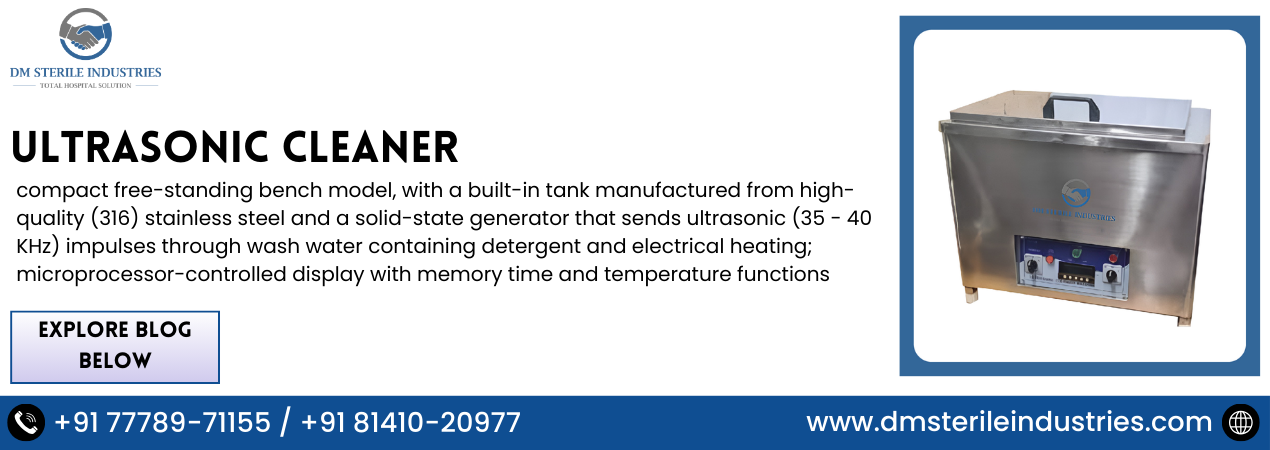
An ultrasonic cleaner is a compact, free-standing bench-mounted system featuring an integrated cleaning tank fabricated from high-grade stainless steel. The system uses ultrasonic sound waves transmitted through a liquid medium to remove contaminants from surfaces that are difficult to clean manually.
These systems are widely used for cleaning surgical instruments, laboratory glassware, precision components, and small industrial parts. Ultrasonic cleaner models are equipped with solid-state generators, typically operating in the 35 to 40 kilohertz frequency range. This frequency range is well suited for fine cleaning applications where surface integrity must be preserved while achieving effective contaminant removal.
Integrated electrical heating and digital control interfaces allow operators to manage cleaning cycles with accuracy and consistency.
Working Principle of Ultrasonic Cleaning Technology
Ultrasonic cleaning operates on the principle of cavitation. Electrical energy supplied to the system is converted into high-frequency sound waves by ultrasonic transducers bonded to the base of the tank. These sound waves travel through the cleaning solution, creating microscopic bubbles that rapidly form and collapse.
The controlled collapse of these bubbles generates localized energy that dislodges contaminants such as blood residues, grease, oils, polishing compounds, and particulate matter. This action reaches crevices, joints, blind holes, and intricate geometries that are inaccessible through manual cleaning or conventional washing methods.
The outcome is uniform and repeatable cleaning across all submerged surfaces.
Construction Materials and Tank Design
Material selection directly influences ultrasonic cleaner performance and service life. The cleaning tank is manufactured from stainless steel grade 316, which provides strong resistance to corrosion, chemicals, and elevated temperatures. This material is particularly suitable for healthcare and laboratory environments where exposure to detergents, disinfectants, and repeated heating cycles is common.
The tank structure is engineered to support even ultrasonic wave distribution while maintaining mechanical stability during extended operation. Reinforced construction minimizes vibration losses and helps maintain consistent cavitation throughout the cleaning zone.
Control System and Operational Safety
Ultrasonic cleaners are fitted with microprocessor-based control systems and digital displays. The control panel is positioned above the liquid level to enhance safety and simplify operation. Operators can accurately set and monitor parameters such as cleaning duration and temperature.
Memory functions enable repeated use of predefined cycles, supporting process consistency in regulated environments. Clear visual displays allow quick verification of operating conditions, reducing the likelihood of incorrect settings during routine use.
Applications of Ultrasonic Cleaners Across Sectors
Ultrasonic cleaners are used in multiple sectors where precision cleaning is critical.
- In healthcare and medical facilities, ultrasonic cleaners are commonly used for pre-cleaning surgical instruments, dental tools, orthopedic devices, and reusable medical accessories. They support infection control protocols by removing organic residues before sterilization.
- In laboratory environments, these systems clean glassware, test components, and analytical tools without damaging surfaces. Consistent cleaning supports accuracy and reliability in testing and research activities.
- In industrial and engineering settings, ultrasonic cleaners are applied for cleaning precision parts, machined components, bearings, valves, and electronic assemblies. The process removes machining oils, polishing residues, and particulate contamination efficiently.
Temperature Control and Heating Functionality
Temperature control significantly influences cleaning effectiveness. Ultrasonic cleaners are designed with adjustable temperature ranges, commonly from 30 degrees Celsius up to 80 degrees Celsius or higher, depending on application needs. Controlled heating improves detergent performance and enhances removal of organic and inorganic residues.
Integrated heaters are matched to tank capacity to ensure stable temperature maintenance throughout the cleaning cycle. This capability is particularly important in medical and laboratory applications where validated and repeatable cleaning parameters are required.
Degassing Function and Accessory Support
Ultrasonic cleaning systems incorporate a degassing function that removes dissolved gases from the cleaning solution prior to use. Degassing improves cavitation efficiency and helps ensure consistent cleaning performance from the beginning of each cycle.
Systems are supplied with appropriately sized wire mesh baskets that support proper placement of instruments or components. The basket design allows ultrasonic waves to circulate freely around all surfaces while preventing direct contact with the tank base.
Technical Specification Range and Capacity Options
Ultrasonic cleaners are available in a range of capacities to meet varied operational requirements. Models differ based on internal tank dimensions, liquid volume, ultrasonic power, and heater load. Smaller units are suitable for clinics and laboratories, while larger systems support hospital CSSD departments and industrial operations.
Each model is engineered to balance ultrasonic output, heating capacity, and tank volume to achieve effective cleaning results. Selection depends on load size, contamination characteristics, and required throughput.
Why Ultrasonic Cleaners Are Essential in Regulated Environments
- Regulated sectors such as healthcare and pharmaceuticals require documented, repeatable cleaning processes. Ultrasonic cleaners support these requirements by providing controlled operating parameters, consistent outcomes, and compatibility with validation protocols.
- The ability to clean complex geometries reduces dependence on manual scrubbing, which can introduce variability and risk of damage. Automated ultrasonic cleaning improves process reliability and enhances staff safety by minimizing direct handling of contaminated instruments.
Local Manufacturing Advantages in Ahmedabad
Ahmedabad offers several advantages for ultrasonic cleaner manufacturing. Access to raw material suppliers, fabrication facilities, and technical service providers supports efficient production cycles. Strong connectivity to healthcare markets in Gujarat and neighboring regions enables timely supply and responsive service support.
Local manufacturing also allows customization based on user requirements, regulatory expectations, and site-specific installation constraints. Buyers benefit from direct communication, faster response times, and readily available technical assistance.
Compliance, Maintenance, and Long-Term Performance
Consistent maintenance is essential for sustained ultrasonic cleaner performance. Regular tank cleaning, appropriate detergent selection, and adherence to operating guidelines help maintain effective cavitation.
Stainless steel construction supports long service life when combined with routine inspection and preventive maintenance. Control systems should be periodically checked to ensure accurate temperature and time control.
In regulated facilities, documentation of cleaning parameters and maintenance activities supports compliance with internal quality systems and external audits.
Frequently Asked Questions
Ultrasonic cleaners are suitable for medical instruments, dental tools, laboratory glassware, precision mechanical parts, electronic components, and small industrial items requiring residue-free cleaning.
When correct frequency, temperature, and detergent are used, ultrasonic cleaning is safe for delicate instruments. Proper loading and cycle selection are important to prevent damage.
Lower frequencies generate stronger cavitation for heavy contamination, while higher frequencies are suited for fine cleaning of delicate surfaces. Most medical applications operate effectively in the 35 to 40 kilohertz range.
Ultrasonic cleaning is a pre-cleaning process and does not replace sterilization. It removes contaminants that can interfere with effective sterilization.
Routine maintenance includes tank cleaning, solution replacement, inspection of transducers, and verification of control settings in line with manufacturer recommendations.
Ultrasonic cleaners designed with industrial-grade components and stainless steel tanks are suitable for regular daily use in healthcare and industrial environments.
Get in Touch
Quick Links
Our Products
Get In Touch
Plot No. 16, Saffron Industrial Park 1. Opp V.K Bhattha, Nr Morriat Industrial Park, Indore Road. Shingarva, Ahmedubod Gujarat -302430.
info.dmsterileind@gmail.com
+91 7778971155
+91 81410 20977
DM STERILE INDUSTRIES | All Rights Reserved.