
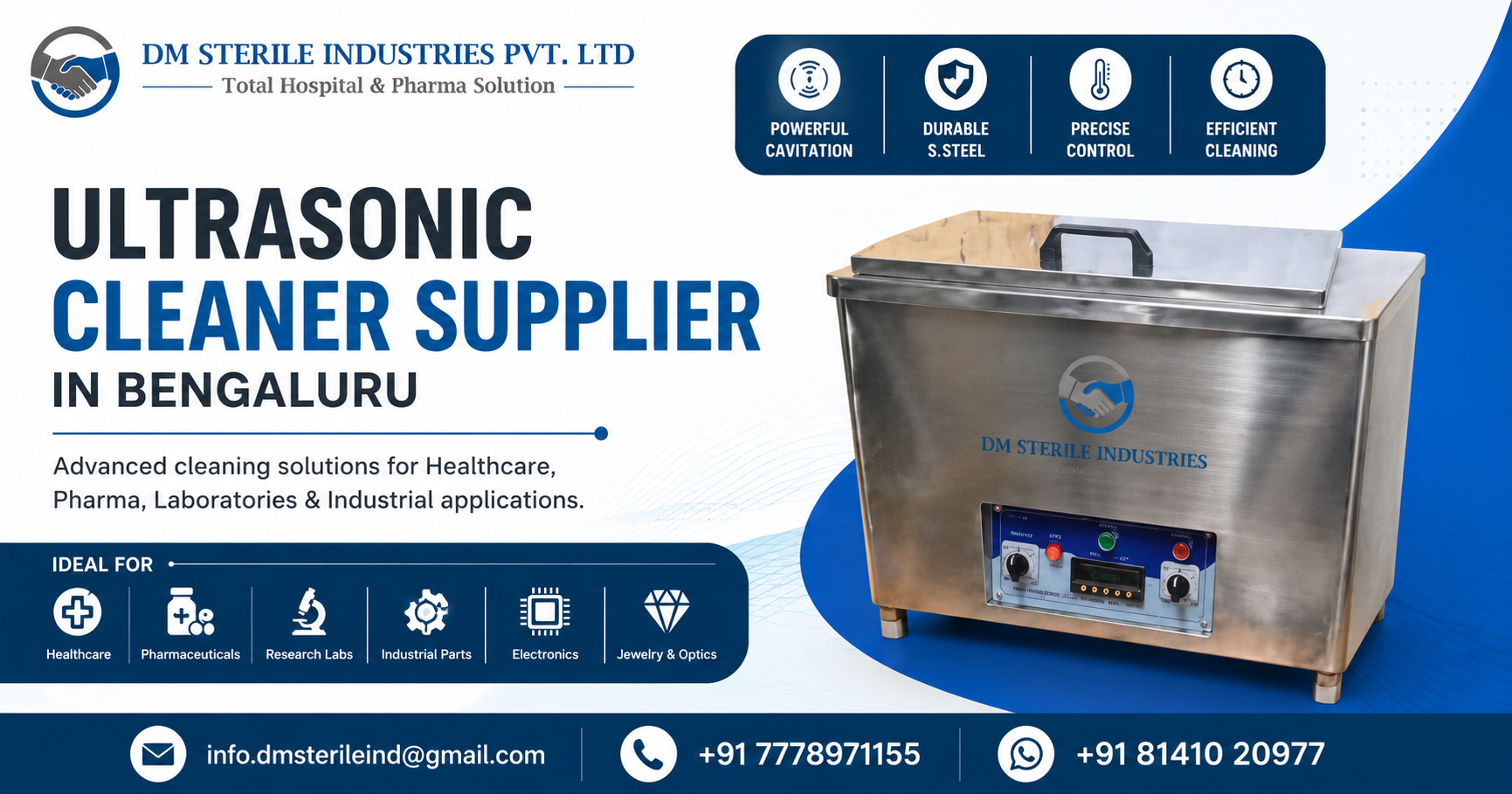
Ultrasonic Cleaner supplier in Bengaluru
Find a reliable ultrasonic cleaner supplier in Bengaluru. DM Sterile Industries offers advanced cleaning solutions for healthcare, pharma, and research.
What is an Ultrasonic Cleaner? — Overview
An ultrasonic cleaner is a sophisticated device that utilizes high-frequency sound waves, typically in the range of 20 to 400 kilohertz, to agitate a cleaning fluid. This agitation creates millions of microscopic cavitation bubbles that rapidly form and collapse. The implosion of these bubbles generates intense localized energy, effectively dislodging and removing contaminants from the surfaces of immersed objects. This process is highly effective for cleaning intricate parts, delicate instruments, and surfaces with complex shapes, ensuring a thorough and uniform clean without the need for harsh chemicals or abrasive scrubbing.
Key Features and Technical Specifications
- Frequency Range: Operates at specific ultrasonic frequencies (e.g., 25 kHz, 40 kHz, 100 kHz) tailored for different cleaning applications.
- Tank Capacity: Available in various sizes, from small benchtop units to large industrial tanks, to accommodate different batch sizes.
- Material Construction: Typically constructed from durable stainless steel (e.g., SS 304, SS 316L) for corrosion resistance and longevity.
- Heating Element: Integrated heating system to maintain optimal cleaning solution temperatures, enhancing cleaning efficacy.
- Timer Control: Adjustable digital timer for precise control over cleaning cycles.
- Power Output: Variable ultrasonic power settings to match the cleaning intensity required for specific contaminants and materials.
- Degas Function: Feature to remove dissolved gases from the cleaning solution, improving cavitation efficiency.
- Basket/Tray: Comes with a perforated basket or tray to hold items securely during the cleaning process.
Industrial Applications and Use Cases
- Healthcare: Sterilization preparation for surgical instruments, dental tools, endoscopes, and laboratory glassware.
- Pharmaceuticals: Cleaning of manufacturing equipment, vials, stoppers, and precision components used in drug production.
- Medical Device Manufacturing: Removing polishing compounds, oils, and particulates from implants, catheters, and intricate device parts.
- Electronics: Cleaning printed circuit boards (PCBs), semiconductor components, and precision electronic assemblies.
- Jewelry and Optics: Polishing debris removal from intricate jewelry pieces, lenses, and optical components.
- Automotive and Aerospace: Cleaning small, complex engine parts, fuel injectors, and precision bearings.
- Research Laboratories: Cleaning glassware, pipettes, and delicate scientific instruments to ensure experimental accuracy.
- Watchmaking: Cleaning intricate watch components and movements.
How to Choose the Right Ultrasonic Cleaner
Selecting the appropriate ultrasonic cleaner involves considering several critical factors to ensure it meets your specific operational needs and delivers optimal results. A careful evaluation of these points will help you make an informed decision and invest in a solution that provides long-term value and efficiency for your Bengaluru-based operations.
- Application and Contaminant Type: Identify precisely what you need to clean and the nature of the contaminants (e.g., oils, grease, polishing compound, biological matter).
- Item Size and Geometry: Consider the dimensions of the items to be cleaned and whether they have intricate details or blind holes.
- Tank Capacity and Dimensions: Choose a tank size that can comfortably accommodate your typical batch of items without overcrowding.
- Required Frequency: Different frequencies are suited for different cleaning tasks; lower frequencies for heavy debris, higher for fine particles.
- Material Compatibility: Ensure the cleaning solution and the cleaner's construction materials are compatible with the items being cleaned.
- Temperature Control: If your cleaning process requires specific temperatures, ensure the cleaner has an effective heating system.
- Power and Throughput: Assess the cleaning power needed and the volume of items you process daily to determine the required throughput.
- Supplier Support and Service: Look for a supplier with a strong reputation for technical support, maintenance, and after-sales service.
Quality Standards and Compliance
For industrial and medical applications, adherence to quality standards and regulatory compliance is non-negotiable. Ultrasonic cleaners used in these sectors should be manufactured to meet stringent quality benchmarks. Look for suppliers who can provide documentation demonstrating compliance with relevant industry standards, such as ISO certifications for quality management systems. For healthcare applications, understanding how the cleaner contributes to the overall disinfection and sterilization workflow is crucial. Verify that the materials used are suitable for the intended environment and that the equipment is designed for reliable, repeatable performance, ensuring it integrates seamlessly into your existing compliance protocols.
Why DM Sterile Industries' Experience and Capability Matters
DM Sterile Industries brings a focused approach to providing advanced cleaning solutions, including ultrasonic cleaners, to the Bengaluru market. Established in 2024, the company is built on a foundation of understanding the critical cleaning needs of sectors like healthcare, pharmaceuticals, and research. Our team is dedicated to sourcing and supplying equipment that meets rigorous performance and reliability standards. We prioritize understanding your specific cleaning challenges to recommend the most suitable ultrasonic cleaner, ensuring it aligns with your operational requirements and quality objectives.
Our commitment extends beyond just supplying equipment; we aim to be a trusted partner. This involves providing clear technical specifications, offering guidance on selection, and ensuring that the solutions we provide contribute effectively to your processes. We focus on delivering equipment that offers consistent performance, durability, and ease of use, backed by responsive customer support.
Installation, Maintenance, and Care Tips
Proper installation and regular maintenance are key to maximizing the lifespan and performance of your ultrasonic cleaner. When installing, ensure the unit is placed on a stable, level surface away from excessive heat or moisture. Always use the recommended cleaning solutions and follow the manufacturer's guidelines for fill levels.
Regular maintenance should include daily draining and rinsing of the tank to remove debris. Periodically, a more thorough cleaning of the tank and transducers may be necessary. Inspect the power cord and plug for any damage before each use. Avoid running the cleaner dry, as this can damage the transducers. For specific maintenance schedules and troubleshooting, consult the user manual or contact DM Sterile Industries for expert advice.
Frequently Asked Questions
Ultrasonic cleaners are highly effective at removing a wide range of contaminants, including oils, greases, polishing compounds, flux, dirt, dust, particulate matter, and biological residues from various surfaces.
Yes, when used with appropriate cleaning solutions and frequencies, ultrasonic cleaners are safe for delicate items. The cavitation process is powerful yet non-abrasive, making it ideal for intricate or sensitive components.
The frequency of solution changes depends on the application and the level of contamination. For heavily soiled items, daily changes may be necessary. For less demanding applications, changing the solution every few days or when it appears visibly dirty is usually sufficient.
It is crucial to use only liquids specifically recommended for ultrasonic cleaning. Water-based solutions with appropriate detergents are common. Avoid using flammable solvents or corrosive chemicals unless the cleaner is specifically designed for such materials, as they can damage the equipment or pose safety risks.
Lower frequencies (e.g., 20-40 kHz) generate larger cavitation bubbles, making them effective for removing heavy debris and cleaning robust parts. Higher frequencies (e.g., 100 kHz and above) create smaller bubbles, providing a gentler yet more thorough cleaning action ideal for delicate items and fine details.
DM Sterile Industries provides comprehensive support, including expert advice on selecting the right ultrasonic cleaner, technical specifications, and responsive after-sales service. We aim to ensure our clients in Bengaluru have a reliable and efficient cleaning solution for their needs.
Conclusion
For businesses in Bengaluru requiring precision cleaning, an ultrasonic cleaner represents a significant advancement in efficiency and effectiveness. Choosing the right supplier is as critical as selecting the right equipment. DM Sterile Industries is committed to providing reliable ultrasonic cleaning solutions, backed by an understanding of your industry's unique demands. By focusing on quality, performance, and customer support, we aim to be your trusted partner in achieving superior cleanliness standards.
Get In Touch
Dm Sterile Industries