
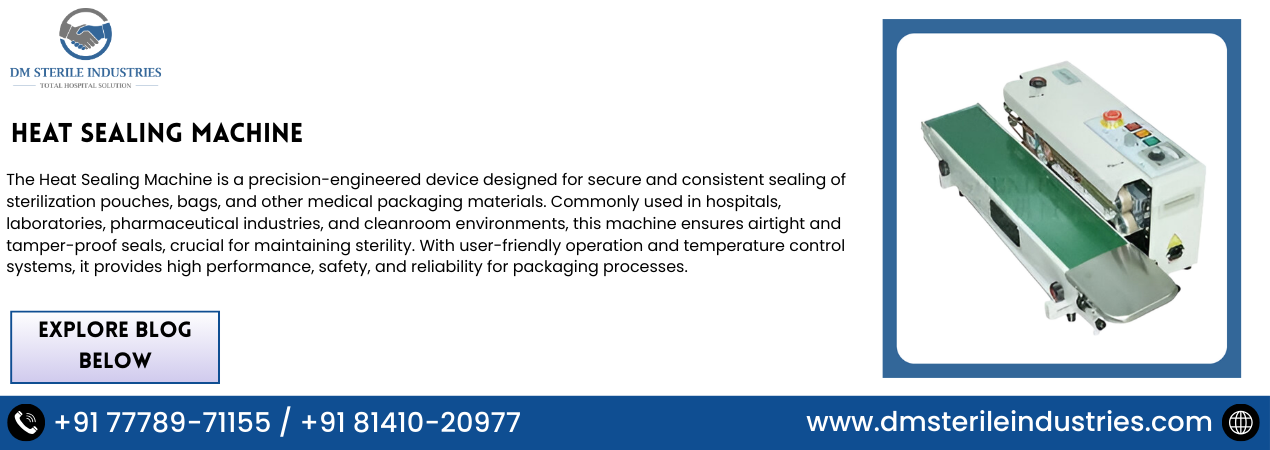
Heat Sealing Machine in Ahmedabad
Heat Sealing Machine in Ahmedabad
A Critical Asset for Sterile Packaging in Healthcare and Pharmaceuticals
In healthcare and pharmaceutical environments, maintaining sterility is not optional; it is a regulatory and operational necessity. One of the most critical steps in the sterilization workflow is secure packaging before sterilization and safe storage afterward.
A heat sealing machine plays a central role in this process by creating consistent, airtight seals for medical pouches, bags, and packaging films. In Ahmedabad, where hospitals, diagnostic centers, pharmaceutical manufacturers, and cleanroom facilities continue to expand, demand for reliable heat sealing machines has grown steadily.
This article provides a clear, practical, and user-focused understanding of heat sealing machines in Ahmedabad. It explains how these machines function, where they are used, why they are essential in sterile environments, and what buyers should consider when selecting the right machine for hospital and pharmaceutical operations.
Understanding Heat Sealing Machines for Sterile Packaging
A heat sealing machine is designed to join thermoplastic materials using controlled heat and pressure. In medical and pharmaceutical settings, it is primarily used to seal sterilization pouches, reels, and bags containing surgical instruments, medical devices, and reusable supplies. The sealed package protects contents from contamination before sterilization and helps preserve sterility during storage and transportation.
Compared to manual sealing methods, modern heat sealing machines offer precise temperature control, adjustable speed, and uniform sealing pressure. This results in repeatable seal quality, which is critical for meeting hospital protocols and quality standards. In Ahmedabad’s healthcare infrastructure, where both private and government hospitals operate high-volume CSSD departments, consistent sealing performance has a direct impact on patient safety.
Why Heat Sealing Machines are Critical in Hospitals & Pharma
In sterile processing workflows, packaging quality is as important as the sterilization process itself. Even when sterilization equipment operates correctly, a poorly sealed pouch can compromise the entire cycle. Heat sealing machines reduce this risk by standardizing the sealing process and minimizing human error.
- Hospitals: Rely on these machines to seal surgical kits, instruments, and reusable medical devices prior to steam or ETO sterilization.
- Pharmaceutical Units: Use them to package components, samples, and sterile products under controlled conditions.
- Labs & Cleanrooms: Depend on precise sealing to maintain contamination-free environments for diagnostic samples.
In Ahmedabad, where hospitals serve patients from across Gujarat and nearby regions, maintaining high sterilization standards is essential. A dependable heat sealing machine helps ensure that sterile barriers remain intact until the point of use.
How a Heat Sealing Machine Works in Practical Operation
A typical continuous band heat sealing machine operates using an electronically controlled heating system combined with a motor-driven conveyor. The operator places the pouch or packaging material onto the conveyor, which carries it through heated sealing bands. These bands apply consistent heat and pressure to fuse the packaging layers together.
Temperature control allows the machine to adapt to different materials such as polyethylene, polypropylene, aluminum foil laminates, and medical-grade films. Speed adjustment ensures that sealing time matches the thermal requirements of each material. Many machines also include embossing mechanisms that imprint batch numbers, dates, or identification codes directly onto the seal.
This combination of automation and control makes heat sealing machines suitable for repetitive, high-volume hospital use while maintaining seal integrity.
Common Applications in Ahmedabad
Heat sealing machines are widely used across Ahmedabad’s healthcare and industrial ecosystem. Their applications are closely aligned with sterilization, packaging, and contamination control requirements.
- CSSD Departments: Sealing sterilization pouches for surgical instruments, trays, and reusable devices.
- Pharmaceutical Facilities: Sterile packaging of components, samples, and medical consumables.
- Diagnostic Laboratories: Sealing specimen packaging and sterile supplies.
- Cleanroom Environments: Preventing particulate or microbial contamination through precise sealing.
- Medical Device Manufacturing: Maintaining packaging consistency and meeting traceability requirements for locally manufactured devices.
Key Technical Characteristics That Matter
When evaluating a heat sealing machine, technical specifications should be assessed based on their practical impact. The temperature range is important because different packaging materials require different sealing temperatures. A wider operating range, often up to 300 degrees Celsius, provides flexibility across multiple applications.
Sealing speed directly affects productivity, particularly in busy hospital departments. Adjustable speed settings help balance output with seal quality. Conveyor load capacity determines how much weight the machine can handle without affecting consistency. Power consumption and electrical compatibility are also relevant, especially in facilities operating multiple machines simultaneously.
Embossing capabilities for date marking and batch identification support traceability, which is increasingly required in regulated healthcare and pharmaceutical environments.
Why Ahmedabad is a Growing Market
Ahmedabad has developed into a major center for healthcare services, pharmaceutical manufacturing, and medical device distribution. The city is home to multi-specialty hospitals, teaching hospitals, diagnostic chains, and pharmaceutical units serving both domestic and export markets. As healthcare infrastructure expands, the focus on standardized sterilization and packaging processes continues to increase.
Demand is driven not only by new facilities but also by the modernization of existing CSSD departments. Many hospitals are replacing manual or outdated sealing methods with automated heat sealing machines to improve efficiency, consistency, and compliance. The city’s proximity to pharmaceutical clusters and industrial zones further supports sustained demand for reliable packaging equipment.
How to Choose the Right Heat Sealing Machine
Choosing a heat sealing machine requires alignment between technical capability and operational needs. Buyers should evaluate the types of materials being sealed, daily throughput requirements, and available workspace. Compatibility with existing sterilization workflows is essential to prevent bottlenecks.
Key evaluation factors include temperature stability, ease of operation, maintenance requirements, and durability under continuous use. Machines intended for hospital environments should offer smooth operation, intuitive controls, and consistent output. Availability of service support and spare parts is also important for minimizing downtime.
For Ahmedabad-based facilities, considering local operating conditions and electrical standards helps ensure long-term reliability.
Operational Benefits
Heat sealing machines offer measurable operational benefits in sterile processing and packaging environments. These advantages directly support quality, safety, and efficiency objectives.
- Consistent Quality: Delivers uniform seal quality, reducing the risk of package failure.
- Improved Productivity: Automated operation minimizes manual handling errors and speeds up processing.
- Regulatory Compliance: Controlled parameters support compliance with hospital and pharmaceutical protocols.
- Traceability: Embossing features simplify documentation and audit processes.
- Reduced Fatigue: In high-throughput environments, automation reduces operator strain and promotes standardized workflows.
Integration with CSSD and Sterilization Workflows
In a modern CSSD setup, the heat sealing machine is positioned after cleaning and inspection and before sterilization. Instruments are packed into pouches, sealed, labeled, and then loaded into sterilizers. Any inconsistency during sealing can compromise the entire process.
A reliable heat sealing machine integrates smoothly into this workflow by maintaining consistent sealing performance across shifts. In Ahmedabad hospitals with increasing surgical volumes, this integration supports efficient operations and faster turnaround times.
Maintenance and Operational Considerations
Regular maintenance is essential to keep a heat sealing machine operating reliably. Routine tasks include cleaning sealing bands, inspecting heating elements, and calibrating temperature controls. Operators should be trained to identify signs of improper sealing, such as incomplete fusion or material distortion.
Selecting a machine with accessible components and clear operating guidelines simplifies maintenance. In regulated environments, proper documentation of maintenance activities also supports compliance and audit readiness.
Frequently Asked Questions
Heat sealing machines commonly seal medical-grade paper-plastic pouches, polyethylene, polypropylene, laminated films, and aluminum foil-based materials used in sterile packaging.
Machines designed for hospital and CSSD environments are built for continuous operation, with controlled temperature and speed to maintain consistent seal quality.
Accurate temperature control ensures proper fusion of packaging materials without damage. Incorrect temperature settings can result in weak seals or material deformation.
Embossing supports batch identification, date marking, and traceability, which are increasingly important for quality control and regulatory compliance.
Machines with adjustable sealing height, width, speed, and temperature can handle a wide range of pouch sizes and materials within a single facility.
By creating airtight, tamper-resistant seals, the machine helps maintain sterility after sterilization, reducing the risk of contamination and infection.
Future Outlook for Heat Sealing Machines in Healthcare
As healthcare standards continue to evolve, the role of packaging in infection control remains critical. Automation, consistency, and traceability are becoming baseline requirements rather than optional features. Heat sealing machines are expected to integrate further with digital tracking systems and standardized CSSD layouts.
In Ahmedabad, where healthcare and pharmaceutical sectors continue to expand, demand for reliable and compliant heat sealing solutions is expected to grow. Facilities that invest in appropriately matched equipment are better positioned for long-term operational stability and quality assurance.
Conclusion
A heat sealing machine is a vital component of sterile packaging workflows in hospitals, pharmaceutical units, and laboratories. Within Ahmedabad’s growing healthcare ecosystem, these machines support consistent sealing, improved efficiency, and compliance with sterilization standards. By understanding how they operate, where they are applied, and which factors matter during selection, facilities can make informed decisions that strengthen sterilization processes and protect patient safety.
Get in Touch
Relevant Tags
Quick Links
Our Products
Get In Touch
Plot No. 16, Saffron Industrial Park 1. Opp V.K Bhattha, Nr Morriat Industrial Park, Indore Road. Shingarva, Ahmedubod Gujarat -302430.
info.dmsterileind@gmail.com
+91 7778971155
+91 81410 20977
DM STERILE INDUSTRIES | All Rights Reserved.