
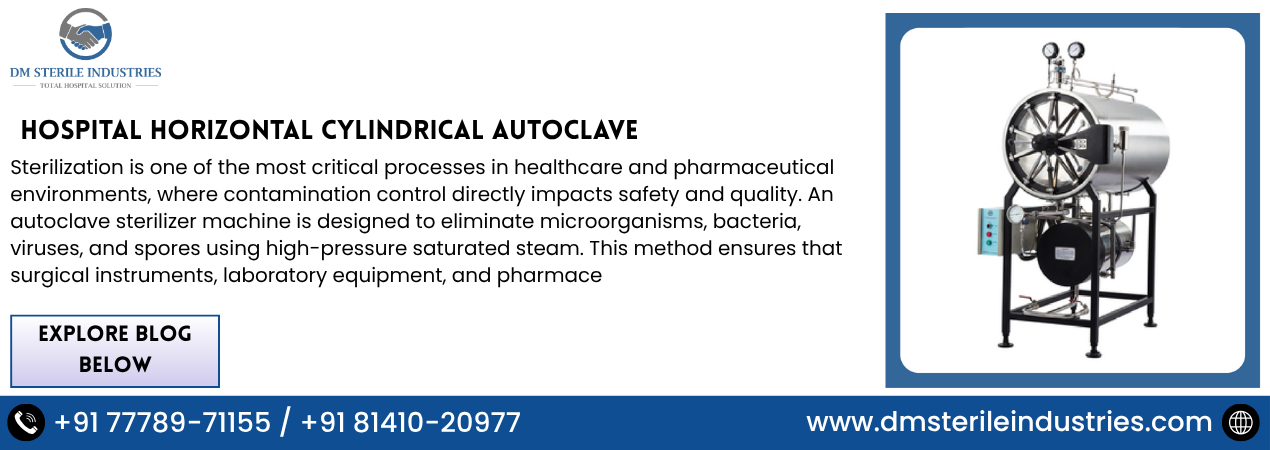
Hospital Horizontal Cylindrical Autoclave
Hospital Horizontal Cylindrical Autoclave
An essential sterilization system used in healthcare environments where instruments, dressings, glassware, surgical tools, and other reusable items need safe and consistent sterilization.
Hospital Horizontal Cylindrical Autoclave
A Hospital Horizontal Cylindrical Autoclave is an essential sterilization system used in healthcare environments where instruments, dressings, glassware, surgical tools, and other reusable items need safe and consistent sterilization. In hospitals, sterilization is more than a routine process; it directly supports infection control, patient safety, and the smooth operation of operating rooms, laboratories, wards, and central sterile supply departments.
DM Sterile Industries provides sterilization equipment designed for medical, laboratory, pharmaceutical, and healthcare applications. The company focuses on practical sterilization solutions that support hygiene, safety, and dependable performance. Its Horizontal Cylindrical High-Pressure Steam Sterilizer is built to handle regular sterilization loads with uniform steam circulation, reliable temperature control, and safety-focused construction.
The horizontal cylindrical chamber design makes this autoclave suitable for hospitals that require efficient loading, proper steam penetration, and consistent cycle results. Its stainless steel construction, high-pressure steam operation, and advanced safety features make it useful for sterilizing surgical instruments, culture media, dressings, laboratory glassware, and hospital-use materials.
Understanding Hospital Horizontal Cylindrical Autoclave
A hospital horizontal cylindrical autoclave is a steam sterilizer designed with a horizontally positioned cylindrical chamber. This chamber shape allows steam to circulate effectively around the load, helping achieve uniform sterilization. The equipment works by using saturated steam under pressure to destroy microorganisms, bacteria, spores, and other contaminants from medical and laboratory items.
In hospital operations, sterilization equipment must be reliable because instruments often pass through repeated cycles of cleaning, packing, sterilization, storage, and reuse. A properly designed autoclave helps maintain this workflow by offering controlled temperature, pressure, and cycle timing. The horizontal loading arrangement also supports easier handling of trays, containers, glassware, and instrument packs.
This type of autoclave is commonly used in hospitals, nursing homes, surgical centers, microbiology laboratories, pharmaceutical facilities, and research institutes. It is preferred where higher load capacity, better chamber access, and steady sterilization performance are required.
How a Horizontal Cylindrical Steam Sterilizer Works
A horizontal cylindrical steam sterilizer works on the principle of moist heat sterilization. Steam is generated and introduced into the chamber under controlled pressure. As the temperature rises, steam penetrates the loaded materials and transfers heat efficiently. This process helps eliminate microorganisms from instruments and other sterilizable items.
During the process, the chamber must remain sealed and stable. Safety valves, pressure gauges, steam release systems, water level indicators, and door safety locks help maintain safe operation. Once the cycle is completed, steam is released safely, and the sterilized load can be removed after proper cooling and handling.
Importance of Horizontal Cylindrical Autoclave in Hospitals
Hospitals handle a wide range of reusable instruments and materials that must be sterilized before use. Surgical instruments, dressing materials, glassware, rubber goods, culture media, and laboratory tools may carry contamination if they are not properly processed. A hospital horizontal cylindrical autoclave helps reduce this risk by providing dependable steam sterilization.
In infection control practices, sterilization is one of the most critical steps. Improper sterilization can increase the risk of hospital-acquired infections and affect the quality of patient care.
The horizontal cylindrical design is also helpful for departments where load handling needs to be simple and practical. Front-loading access allows operators to place trays and sterilization packs conveniently. This supports better workflow in busy hospital environments where sterilization cycles are performed multiple times a day.
Key Features of Hospital Horizontal Cylindrical Autoclave
A well-designed hospital horizontal cylindrical autoclave includes several features that support safety, durability, hygiene, and efficient sterilization. These features are important for daily hospital use, where equipment must remain reliable over the long term.
- Horizontal cylindrical chamber for uniform steam distribution
- Stainless steel construction using SS 304 or SS 316 material
- Double-wall or triple-wall design for better heat retention
- Digital microprocessor controller or analog thermostat option
- Adjustable working pressure for sterilization cycle control
- Temperature range suitable for standard hospital sterilization
- Safety valve, pressure gauge, and steam release valve
- Door safety lock for secure chamber operation
- Water level indicator for safer handling
- Front-loading design for convenient load placement
- Insulated body to reduce heat loss
- Suitable for surgical instruments, dressings, glassware, and media
These features help the autoclave perform efficiently while maintaining safety for operators and hospital staff.
Construction and Material Quality
Material selection is important in hospital sterilization equipment because the chamber is exposed to steam, pressure, heat, and moisture. Stainless steel is commonly used because it offers corrosion resistance, strength, hygiene, and easy cleaning. SS 304 and SS 316 are widely preferred for sterilization chambers and related components.
A double-wall or triple-wall construction helps improve thermal efficiency and safety. The outer structure supports durability, while the inner chamber is designed to withstand sterilization conditions. Insulation materials such as high-density glass wool or ceramic fiber help reduce heat loss and support energy-efficient operation.
The cylindrical chamber design also contributes to pressure stability and smooth steam movement. Smooth internal surfaces reduce areas where residue may collect, supporting better hygiene and easier maintenance.
Applications of Hospital Horizontal Cylindrical Autoclave
A hospital horizontal cylindrical autoclave is used across different medical and laboratory departments. Its application depends on the load type, chamber capacity, and sterilization cycle requirement.
Common applications include:
- Sterilization of surgical instruments
- Sterilization of hospital dressing materials
- Sterilization of laboratory glassware
- Processing of culture media
- Sterilization of reusable medical tools
- Use in microbiology laboratories
- Use in pharmaceutical testing areas
- Sterilization support for operation theatres
- CSSD and hospital sterilization departments
- Research and clinical laboratory applications
Because hospitals work with different sterilization loads, the autoclave should be selected based on chamber size, pressure control, safety systems, and daily usage requirements.
Technical Considerations Before Selection
Selecting the right hospital horizontal cylindrical autoclave requires a practical evaluation of hospital workflow and sterilization needs. Chamber size, load quantity, cycle frequency, control type, and safety requirements should be reviewed before choosing a model.
Important selection points include:
- Chamber capacity and internal dimensions
- Type of materials to be sterilized
- Daily sterilization load volume
- Required operating temperature and pressure
- Manual, semi-automatic, or automatic control preference
- Door type and loading convenience
- Available power supply
- Safety features and pressure protection
- Cleaning and maintenance requirements
- Compatibility with hospital sterilization workflow
A suitable autoclave should match the actual usage pattern of the hospital. Oversized or undersized equipment can affect efficiency, energy use, and workflow management.
Role of Safety Features in Steam Sterilization
Safety is a major factor in high-pressure steam sterilization. Since the autoclave operates with heat, steam, and pressure, it must include dependable safety systems. Automatic pressure cut-off helps prevent unsafe pressure buildup. Safety valves provide additional pressure release protection. Door locking systems help ensure that the chamber is not opened during unsafe conditions.
Pressure gauges and temperature controllers help operators monitor the sterilization process. Water level indicators support safe steam generation and help prevent operational issues. Steam release valves allow controlled depressurization after cycle completion.
In hospital use, these safety features are not optional. They support operator protection, equipment reliability, and consistent sterilization performance.
Maintenance and Operational Care
Regular maintenance helps improve autoclave performance and service life. Hospitals should follow proper operating procedures and scheduled inspection practices. The chamber should be cleaned as recommended, and seals, valves, gauges, and control systems should be checked regularly.
Basic maintenance practices include:
- Cleaning chamber surfaces after use
- Checking door gasket condition
- Monitoring pressure gauge accuracy
- Inspecting safety valves periodically
- Ensuring proper water level before operation
- Avoiding overload inside the chamber
- Using suitable packaging for sterilization loads
- Following recommended cycle settings
- Keeping records of sterilization cycles
Proper loading is also important. Steam must reach all surfaces of the sterilization load. Overloading the chamber or placing materials too tightly can affect steam penetration and reduce sterilization effectiveness.
Hospital Sterilization Workflow and Autoclave Performance
A hospital autoclave works best when it is part of a proper sterilization workflow. Instruments should be cleaned before sterilization because organic residue can interfere with the process. After cleaning, items should be dried, packed, arranged properly in trays, sterilized, cooled, and stored in a clean area.
The autoclave's performance depends not only on machine design but also on operator handling. Correct cycle selection, proper load arrangement, and regular monitoring help achieve reliable results. For hospitals, this creates a safer and more organized sterilization system.
A horizontal cylindrical autoclave supports this workflow by offering practical loading access, stable steam circulation, and dependable cycle control. This makes it useful for departments where sterilization is a daily requirement.
Why DM Sterile Industries for Hospital Horizontal Cylindrical Autoclave
DM Sterile Industries offers sterilization equipment for hospital, laboratory, pharmaceutical, and industrial applications. The company provides autoclave systems designed with durable construction, stainless steel chambers, safety features, and practical control options. Its horizontal cylindrical steam sterilizer is suitable for healthcare facilities that require consistent sterilization performance and long-term usability.
The equipment is designed to support uniform steam penetration, safe pressure handling, and convenient operation. With options such as SS 304 or SS 316 construction, double or triple-wall design, microprocessor or analog controls, and multiple chamber sizes, hospitals can select a model based on their sterilization requirements.
Conclusion
A Hospital Horizontal Cylindrical Autoclave plays an essential role in medical sterilization by providing safe, uniform, and reliable steam-based sterilization for hospital instruments and materials. Its cylindrical chamber, stainless steel construction, pressure control, safety systems, and front-loading design make it suitable for hospitals, laboratories, research centers, and pharmaceutical environments.
For healthcare facilities, selecting the right autoclave means looking beyond capacity alone. Chamber design, material quality, safety features, temperature control, pressure stability, and maintenance support all influence long-term performance. DM Sterile Industries provides horizontal cylindrical steam sterilizers designed to support practical hospital sterilization needs with dependable operation and hygienic construction.
Frequently Asked Questions
A Hospital Horizontal Cylindrical Autoclave is a steam sterilization machine designed with a horizontal cylindrical chamber. It uses high-pressure saturated steam to sterilize surgical instruments, dressings, glassware, culture media, and other hospital materials. It is commonly used in hospitals, laboratories, pharmaceutical facilities, and healthcare departments.
Steam sterilization is important because it helps eliminate microorganisms, bacteria, spores, and contaminants from reusable medical items. Hospitals rely on proper sterilization to support infection control, patient safety, and hygienic reuse of surgical and laboratory instruments.
A horizontal cylindrical autoclave can sterilize surgical instruments, dressing materials, laboratory glassware, culture media, stainless steel trays, and other steam-compatible hospital items. The exact suitability depends on the material type, packaging method, and recommended sterilization cycle.
The working temperature of a hospital autoclave commonly ranges from 121°C to 134°C. The selected temperature depends on the sterilization load, cycle requirement, pressure setting, and hospital process guidelines.
Important safety features include a pressure gauge, safety valve, steam release valve, automatic pressure cut-off, water level indicator, and door safety lock. These features help control pressure, support safe operation, and reduce risk during sterilization cycles.
A hospital should maintain the autoclave by cleaning the chamber regularly, checking door gaskets, inspecting valves, monitoring gauges, avoiding overloading, and following the recommended operating procedure. Regular maintenance helps improve sterilization consistency and equipment life.
Yes, a horizontal cylindrical autoclave is suitable for CSSD and hospital sterilization departments where instruments, trays, dressings, and other reusable items require regular steam sterilization. The chamber size and control features should be selected according to the department's daily load requirement.
Quick Links
Our Products
Get In Touch
Plot No. 16, Saffron Industrial Park 1. Opp V.K Bhattha, Nr Morriat Industrial Park, Indore Road. Shingarva, Ahmedubod Gujarat -302430.
info.dmsterileind@gmail.com
+91 7778971155
+91 81410 20977
DM STERILE INDUSTRIES | All Rights Reserved.